
THE PRODUCTIONS
You're Dead!: a release show designed as a single event
- YEAR
- 2014
- FOR
- Album release
- DISCIPLINE
- Event design
A tour is a design that must survive being rebuilt nightly in unknown rooms. A release show is a design for one night, in one room, that will never be rebuilt, and almost every decision inverts.

A release show is a useful counter-example to everything else in this archive. Every touring design here is shaped by constraints that a one-off simply does not have, and seeing what designers do when those constraints are removed is informative about how much of touring aesthetics is actually logistics.
What the constraints were hiding
Touring design is shaped by three requirements that have nothing to do with how anything looks: it must pack, it must assemble quickly by a crew in the dark, and it must work in rooms nobody has measured yet.
Remove those and the design space widens immediately. Single venue work can be built to the building, can occupy the audience space, can use structure that would never survive a truck pack, and can rely on sightlines that actually exist rather than on ones that might.
One night, no second chance
The compensating difficulty is that there is no run. A tour’s opening night is a rehearsal for the second; an album event has only the opening night.
This pushes event design toward heavy previs and long pre-programming, because everything that can be resolved before the room has to be resolved before the room. It also pushes toward fewer moving parts, the ambition goes into the idea rather than into the mechanism.
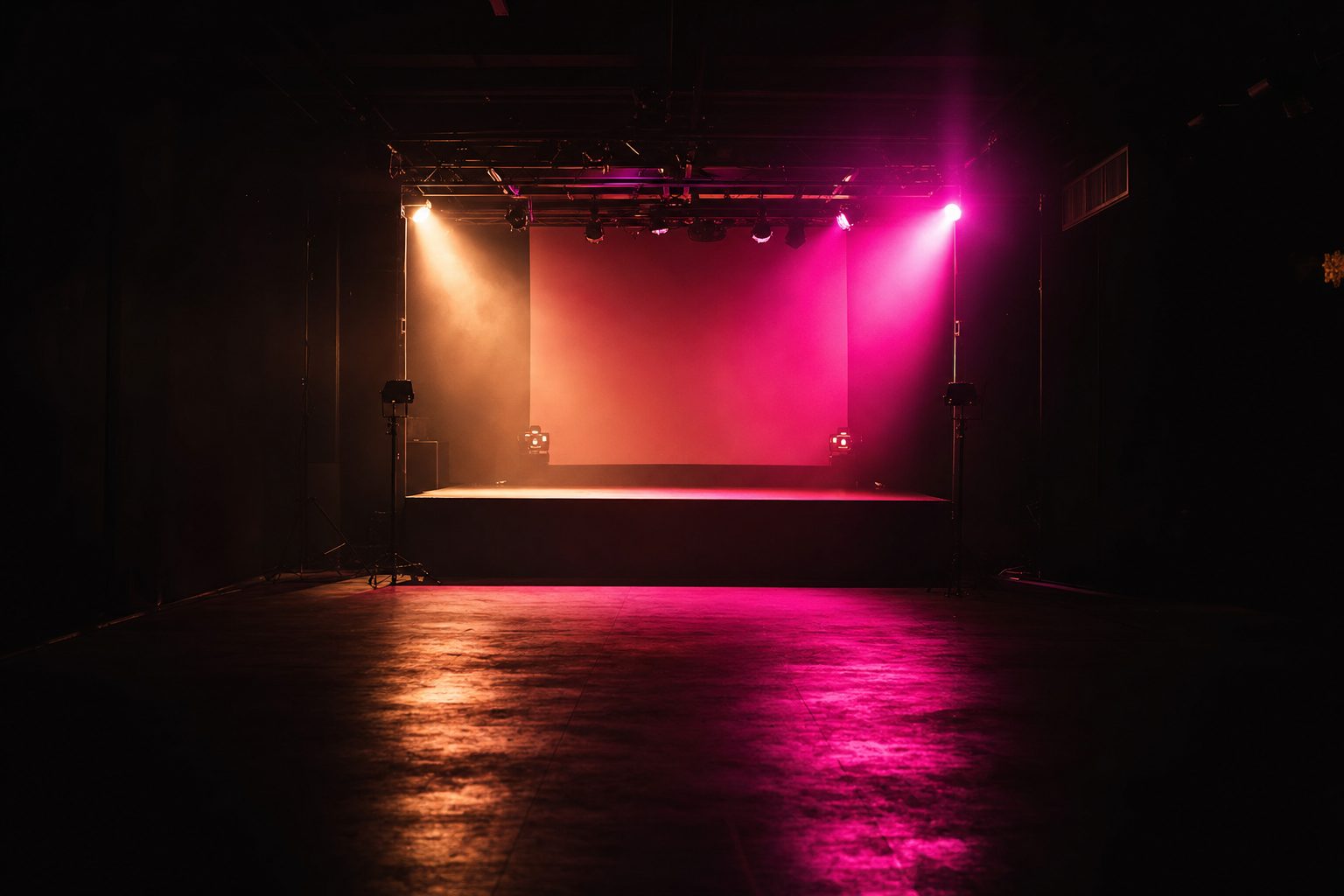
Everything visible was designed for this room and no other. That removes the constraint that shapes almost every other entry in this archive (the requirement that a design assemble identically in a different building tomorrow) and what is left is a much freer problem.
The freedom is real but narrow. There is no second night to correct anything on, no accumulated crew knowledge, and no chance to discover in week two that a cue does not work. A one-off trades the touring constraint for an absence of iteration.
Where techniques get tried first
The reason these shows matter beyond their own evening is that they are where approaches get proven. Without the packing and reliability requirements, a designer can attempt something once and see whether it reads.
What travels afterwards is the idea, not the build. A technique that works in one room gets rebuilt to survive the road, which nearly always means simplifying it until it assembles the same way every night. Several of the touring designs documented here have exactly that ancestry.
Where the technique went next
Single-venue work is where techniques get tried before they are asked to survive a routing. The ideas here about treating a room as one designed object reappear, constrained, in the touring installation, and the same freedom taken to a much larger site is the architectural projection.
What changes when the design has to pack is set out under stage architecture, and the discipline that decides what a one-off is aiming at, with no tour to refine it, is art direction.
How this page is sourced
What is recorded: the design intent, the arrangement, the technical problem it set out to answer, and the consequences for touring. What is not recorded: fixture counts, equipment models, lumen figures or content specifications, which appear in trade coverage inconsistently and are not reproduced where a single source cannot be identified.
Coverage from the period is gathered under the field in print, publisher and date kept on every entry. Previs, sightline and pre-programming are defined in the glossary rather than explained twice. Where this page’s material comes from, and what it declines to reproduce, is set out on about this site.
The record for one-off shows is thin by nature. There is no routing to generate trade coverage, no second night for anyone to photograph properly, and frequently no production documentation that outlives the crew. What survives is usually a handful of images and whatever the people involved said afterwards.
Questions
the things people ask about thisHow does a one-off show differ from a touring one?
Almost every constraint inverts. A one-off knows its venue exactly, so it can be built to the room; it never has to load in again, so it can be difficult to assemble; and it has no per-night reliability requirement, so it can take risks a tour cannot afford.
Does that make a release show easier?
No, differently hard. There is one performance and no second chance, so anything that fails, fails publicly and permanently. Touring shows get better across a run; an event design is judged on its first and only night.
What can a single-venue design do that a tour cannot?
Fit the room. It can use the building’s own geometry, occupy the audience space, run sightline-specific effects and use structure that would never survive a truck pack. Single venue work is where the strange ideas live.
Why are release shows worth documenting?
Because techniques often appear there first. Without the reliability and packing constraints, an album event is where an approach gets tried before anyone commits it to a routing, and several standard touring techniques started as one-night experiments.
What carries from a one-off into later touring work?
The idea, rarely the implementation. A technique proven in a room gets rebuilt to survive the road, which usually means simplifying it until it can be assembled by a tired crew in the dark.