VISUAL
The productions that defined the form of modern concert visuals
A handful of productions between 2013 and 2017 did more to set the current shape of concert visuals than a decade of incremental touring. They are worth documenting as engineering, not as spectacle.
How this record is kept
three things per entry, two threads throughoutEach entry here records three things: what the production was, the technical problem it set out to answer, and which discipline carried the weight. They are documented from published material.
Two threads run through the whole set. The first is depth, the repeated finding that separating a picture physically beats increasing its resolution, which appears first in the stacked-plane designs and reappears years later in volumetric LED. The second is packing: a surprising share of what reads as aesthetic choice turns out, on inspection, to be a decision about what fits in a truck and assembles the same way every night.
Why 2014 to 2017 is the interesting window
Three things arrived within a few years of each other: affordable real-time rendering, fine-pitch LED that could be flown rather than stacked, and mapping software mature enough to be trusted on a routing. Any one of them would have produced incremental change. Together they opened a space that a small number of productions explored very quickly.
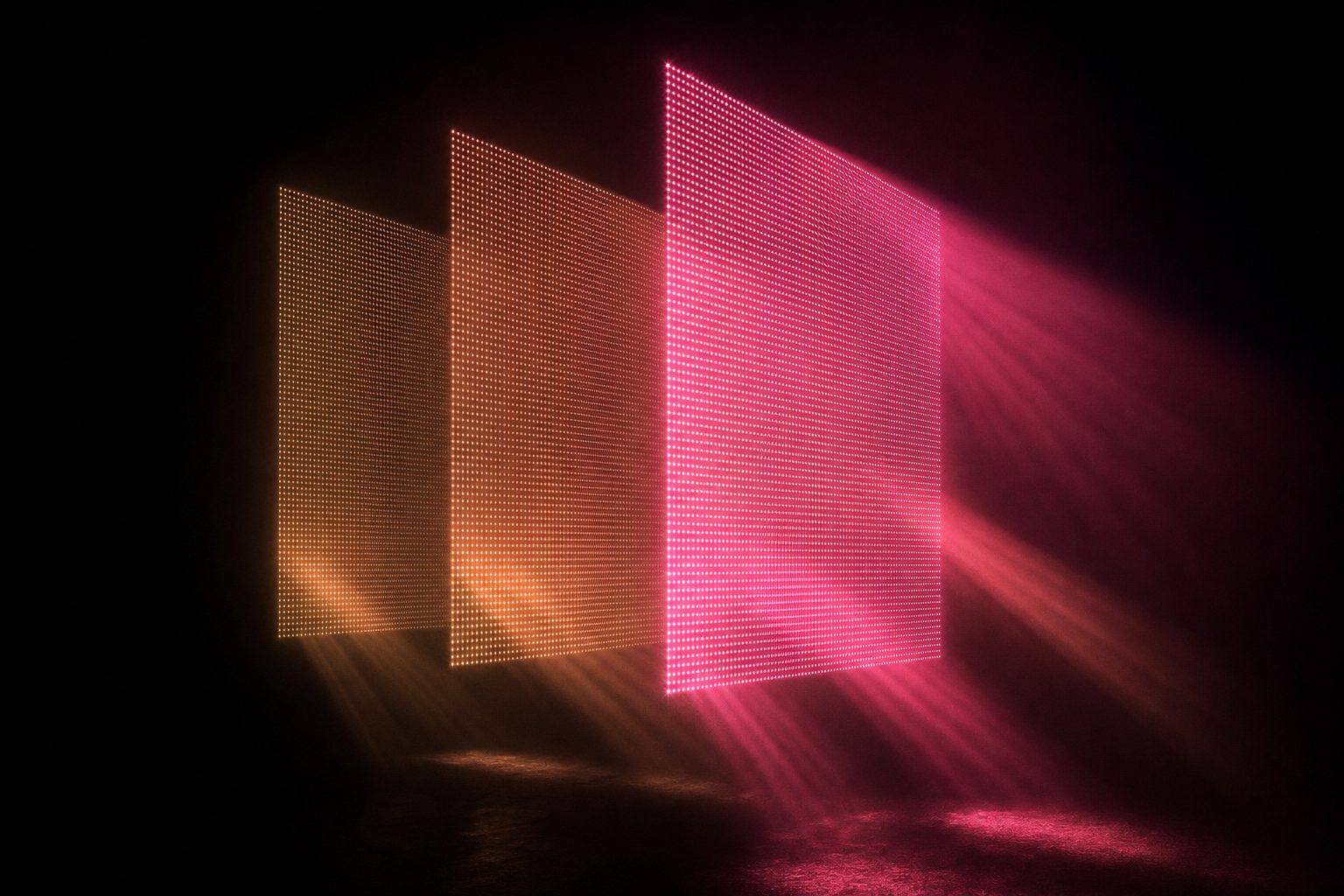
What makes the period legible in hindsight is that the same problem was attacked from several directions at once, by people who published enough about their solutions to be compared. A performance sculpture in three planes and a closed cube with the performer inside it are answers to the same question about depth, arrived at a year apart, with almost nothing else in common.
The window closes not because the ideas ran out but because they became standard. By 2018 the techniques here are a specification line rather than an experiment, which is the usual sign that a form has settled.
The problems these productions were actually solving
Depth on a flat surface. An LED wall is a plane, and a plane cannot be made deep by adding pixels to it. Two of the entries here solve that physically instead: stacked translucent planes in 2014, and an array resolving true volume in 2017. The technique is documented under LED and volumetric.
Surfaces that will not hold still. A cube that rotates, a scenic piece that tracks, a building that was never meant to be a screen. The cube and the Opera House sit at opposite ends of the same discipline (one moves and is small, the other is enormous and listed) and both are projection mapping problems before they are anything else.
Rooms that fight the picture. A fixed acoustic shell reflects, frames and constrains everything placed in front of it, and an open desert field removes the surfaces a designer normally leans on while adding daylight. Neither is a content problem. Both are questions about where anything can physically stand.
Surviving a routing. Three consecutive arena runs is a different discipline from a one-off: what carries over between them is a visual language and a set of parts that assemble identically in a different building every night. A performance installation and a single release night are the opposite case, built once, for one room, with the constraints of touring removed.
How to read an entry
Each page states what is documented and what is not. Where the published record is thin the page says so rather than filling the gap, and where a figure is contested both versions appear. Nothing here reconstructs a rig from a photograph: a cable count that cannot be sourced is not reported.
The productions are credited to the people the published record credits. Where a designer, studio or production company is named, it is because a source names them in that role. How the writing here is sourced is set out on about this site.
Where the technique is explained
These pages record what happened. The disciplines that made it possible are documented separately, because the same technique recurs across several productions and belongs in one place: stage and scenic design covers the half decided before anyone runs anything, and real-time and VJ craft the half that happens under a clock. The software involved is under the toolchain, including the alignment tools that most of the mapped entries depend on and the pixel-pitch arithmetic behind every wall specification here. Terms are defined once in the glossary, and contemporaneous coverage is collected under the field in print.
In this section
9 pages- 2014 Layer3 A performance sculpture built from three stacked planes, chosen for depth rather than resolution. Read →
- 2015 Hypercube A projection cube with the performer inside it — a closed form with no easy surface anywhere on it. Read →
- 2015-16 Coachella Light Shows What changes when the room is an open desert field and the only structure is the beam itself. Read →
- 2016 Sydney Opera House Mapping a listed building: geometry you must measure rather than invent, and projectors the site chooses. Read →
- 2016 Hollywood Bowl A fixed acoustic shell that reflects, frames and constrains everything placed in front of it. Read →
- 2017 Prophecy Tour A performance installation designed as one object, and what that costs when the routing changes. Read →
- 2017 Pardon My French A volumetric LED array producing real parallax rather than a rendering of depth. Read →
- 2015-17 The Weeknd Tours Three consecutive arena runs, and what carries over between them when the rig does not. Read →
- 2014 You're Dead! Release A one-off release show: what designers do when the touring constraints are removed. Read →
Questions
the things people ask about thisHow were these productions selected?
By whether they solved a technical problem whose solution is still in use, and by whether there is enough published material to document them accurately. Several very well-known shows are absent because they were refinements rather than departures.
Why do some entries carry far more detail than others?
Because the published record is uneven. A show that toured for two years and was covered by the trade press leaves far more behind than a one-night installation, however influential it turned out to be. Where the material is thin the entry stays short rather than being padded with inference.
Why is the period so narrow?
Because it was unusually concentrated. The convergence of affordable real-time rendering, fine-pitch LED and mature mapping software happened within a few years, and a small number of productions explored the resulting space very quickly.
How do these connect to the craft pages?
Every entry links to the discipline that carried its weight. The intention is that a reader arriving on a production page can move in one click to how the technique actually works; see stage and scenic design.