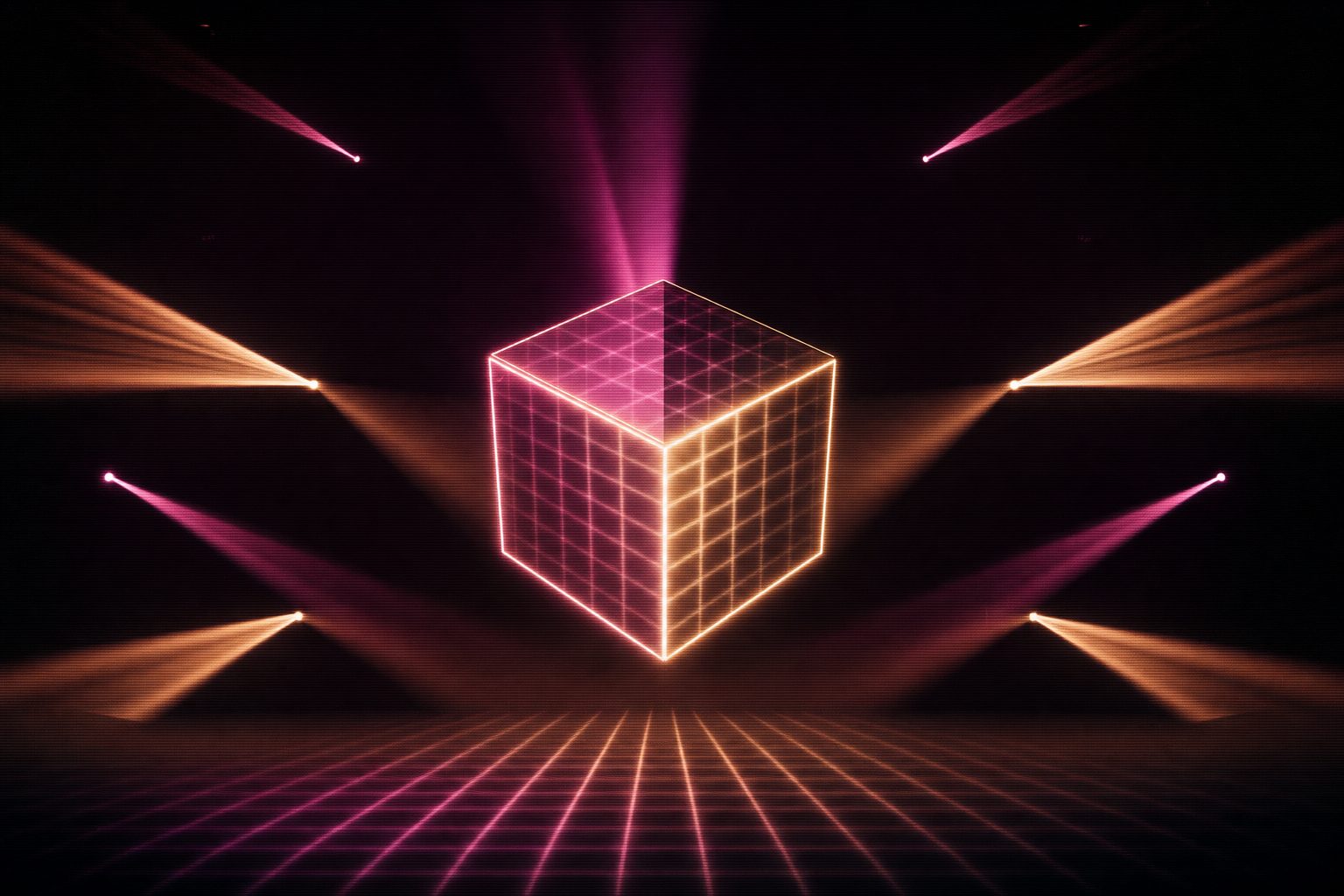
THE PRODUCTIONS
The Hypercube visual show: how a Flying Lotus projection cube was mapped in 2015
- YEAR
- 2015
- FOR
- Flying Lotus
- DISCIPLINE
- Projection mapping
Where Layer3 opened the picture out into planes, Hypercube closed it into a solid. A performer inside a mapped cube is a projection problem with no easy surface anywhere on it.
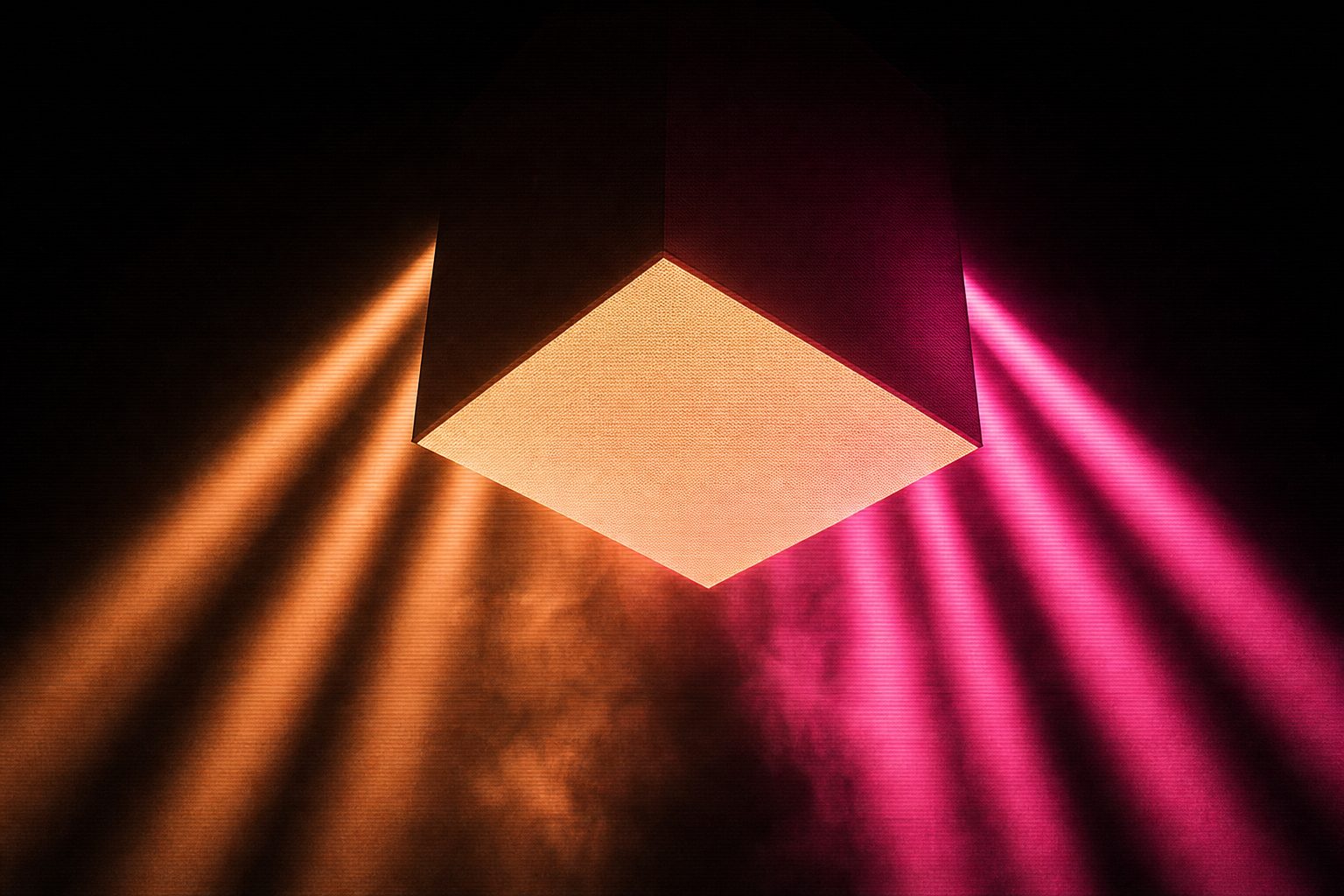
How the Hypercube projection show was built starts with one inversion. The Hypercube visual show is the direct descendant of Layer3 and its formal opposite. The earlier design opened the picture into separated planes; this one closed it into a single solid with the performer inside. Both are attempts to give the image a body.
As a technical object, a projection cube is unforgiving. There is no face square to a projector, no throw distance shared between surfaces, and no seat from which the whole thing is visible. Every one of those is a design constraint before it is a problem.
That decision sets everything downstream. A performance sculpture the audience walks around has no back, so every choice about content, rigging and light has to hold from every seat at once.
Multiple projectors, one projection cube
Covering a cube takes several machines placed around it, each responsible for a face or two, each with its own throw and its own mapped warp. Where their coverage overlaps, the brightness has to be ramped down through the overlap so the seam does not read as a bright band, the edge blending problem, repeated at every shared edge.
Calibration for this kind of object is slow, and it has to be repeatable, because it happens again in a different room tomorrow.
Authoring the Hypercube visual show in unwrapped geometry
The decisive choice is to treat the cube as one folded surface rather than six flat ones. Content drawn per face produces an object that looks like six screens bolted together; content drawn in the unwrapped geometry, with motion continuing across the folds, produces an object that reads as solid.
This is why previs is load-bearing on a design like this. The unwrap is an output of the model, and content cannot start without it.
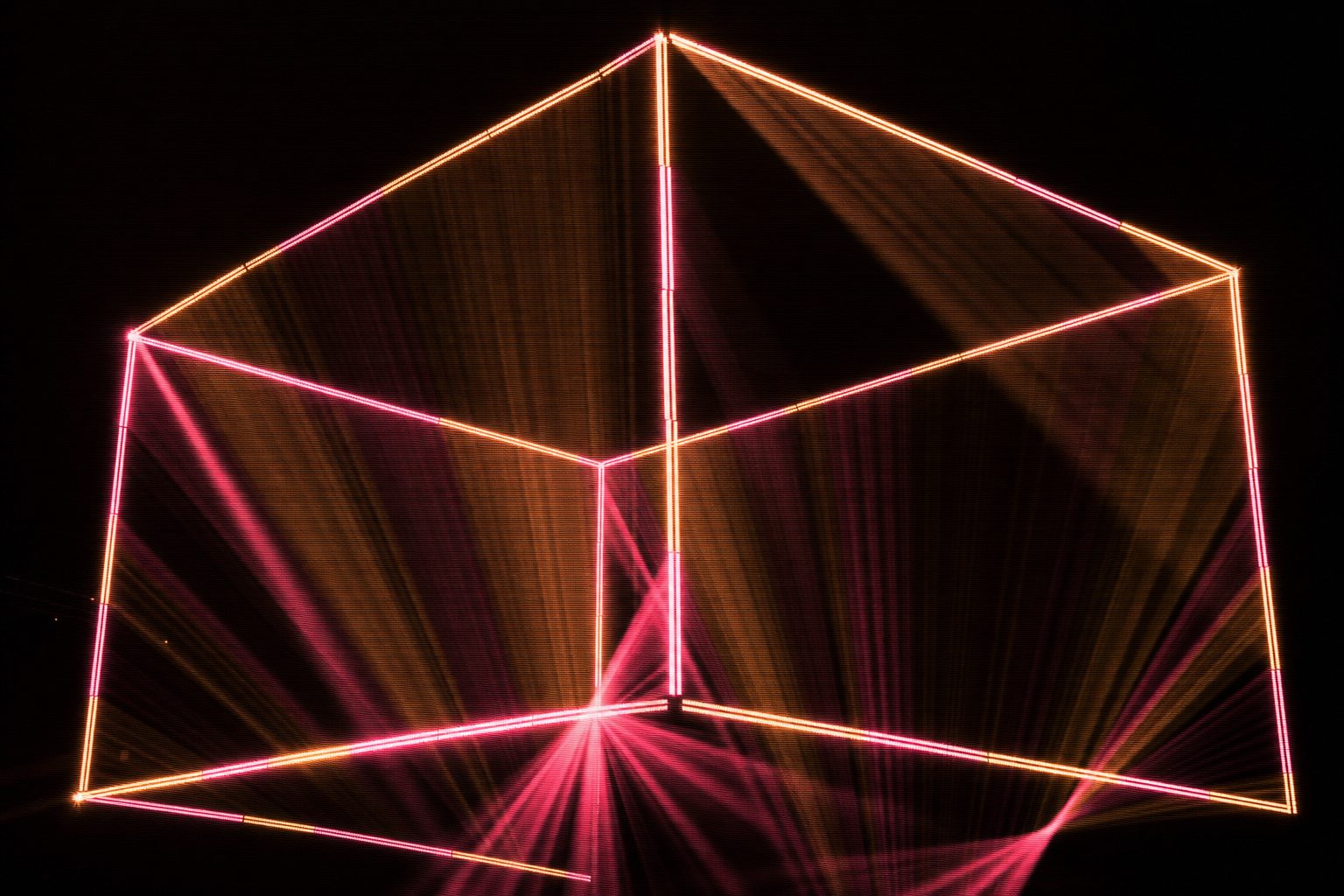
A cube has no easy surface anywhere on it. Every face is angled away from most of the room, and every edge is a place where two mapped surfaces have to agree about a line that is only correct from one viewing position.
Which is why the object is composed rather than the image. Content that reads as a picture wrapped around a box falls apart at the corners; content authored to the unwrapped geometry treats the seams as part of the form and survives being walked around.
Composition without a front: a performance sculpture in the round
Screen design assumes an audience looking at a rectangle. A cube has no front. Any given seat sees two or three faces, from an angle, and no seat sees the composition the designer sees in the model.
Designs that survive this tend to be built from continuous motion and state rather than from framed images, the object is doing something, everywhere, rather than showing something, somewhere. It is much closer to lighting a sculpture than to designing a screen, which is why the discipline boundary with light programming gets blurry on shows like this.
Where the Flying Lotus staging went next after 2015
The closed form is the intermediate step between free-standing separated planes and panels stacked into actual volume: the same pursuit of depth, attempted with surfaces that belong to one object rather than three.
The technique is documented under projection mapping, which sets out mesh warping, edge blending and the moving-object problem in general terms. The daily alignment work it implies is covered under the dedicated mapping stage, and the geometry it depends on comes from previs.
Read as a whole, how the Hypercube projection show was built is a lesson about closed forms rather than about one tour: the Hypercube visual show made a performance sculpture out of a geometry that gives the eye nowhere comfortable to rest, and the Flying Lotus staging that followed inherited the problem rather than solving it.
How this page is sourced
What is recorded: the design intent, the arrangement, the technical problem it set out to answer, and the consequences for touring. What is not recorded: fixture counts, equipment models, lumen figures or content specifications, which appear in trade coverage inconsistently and are not reproduced where a single source cannot be identified.
The contemporaneous record is collected under the field in print, where every item keeps its publisher and date. Mesh warp, edge blend and previs are defined in the glossary, which is the one place this site explains its vocabulary. The standard the writing is held to, including how a figure earns its place on the page, is set out on about this site.
Questions
the things people ask about thisWhat was the Hypercube show?
The Hypercube visual show was a touring projection cube built around the performer, with content mapped onto its faces so that the cube read as a single object rather than as several screens. It followed the three-plane Layer3 design and was widely covered during the 2015 festival season.
Why is a cube harder to map than a flat screen?
Because no single projector sees more than a few faces, and each face it does see is at a different angle and distance. That means multiple machines, multiple warps, edge blending where their coverage overlaps, and content authored so that continuity across an edge actually reads. A flat screen has one of each of those problems; a cube has several.
How does content stay continuous across the edges of a cube?
It has to be authored in the unwrapped geometry rather than per face. Draw six independent faces and the eye immediately sees six screens; draw one surface that happens to fold, and the object reads as a solid. Getting this right is a content decision more than a calibration one.
What happens when the cube moves?
The warp has to move with it. On a repeatable, motorised path the mesh can be animated along the same curve on the same clock, which is the reliable approach for touring. This is covered in general terms under projection mapping.
Did the audience see the whole object at once?
No, and the design accounted for it. A cube presents at most three faces to any given seat, so the composition has to work from many partial views rather than from one privileged angle, closer to sculpture than to screen design.