CH 03 · THE CRAFT
Stage architecture: truss spans, load paths and what can hang
- DISCIPLINEProduction
- DECIDESEverything
- FAILS LATECatastrophically
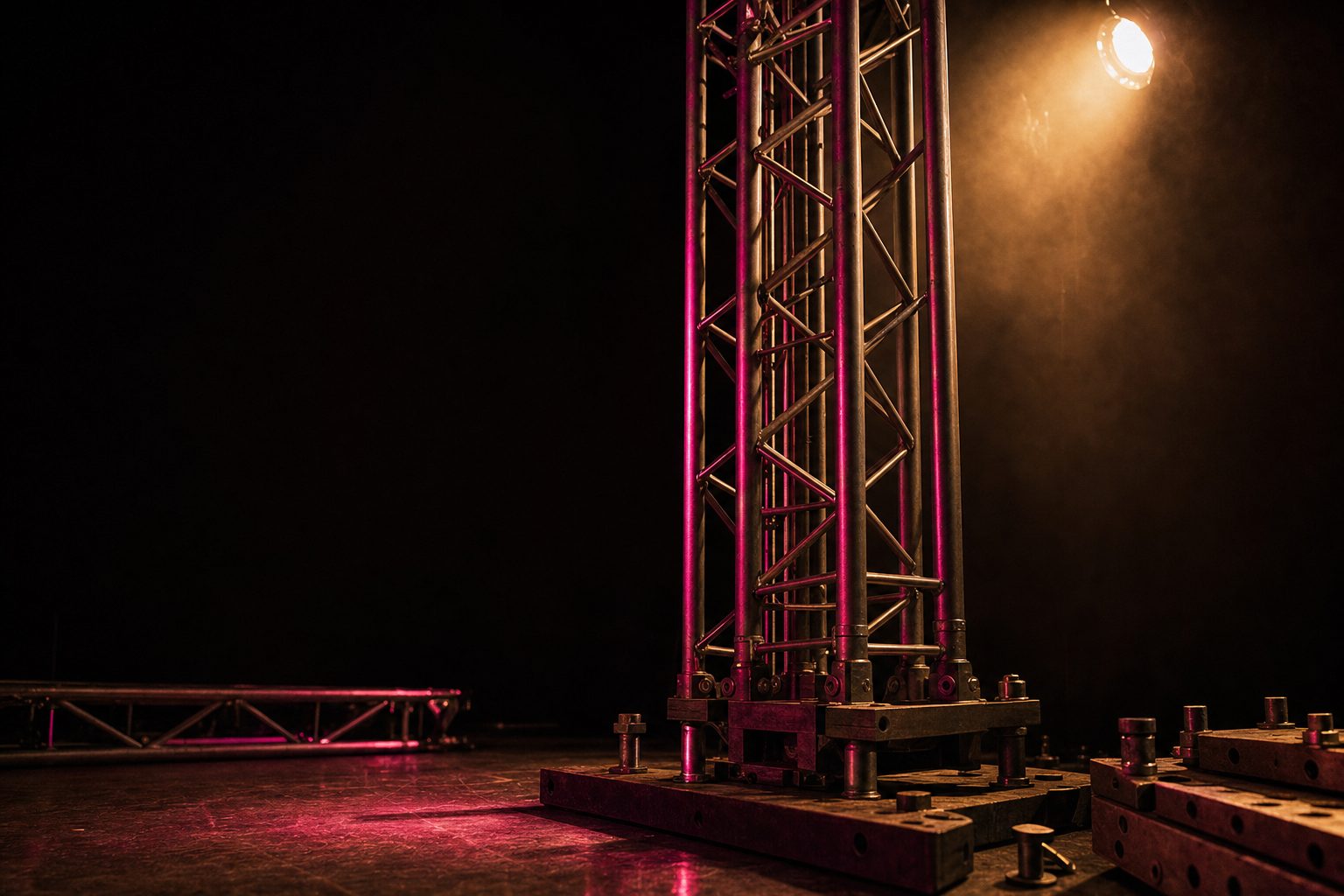
The set is a structure before it is a screen. Every surface the picture lands on has to be held up by something, and the something has a limit, which is why stage architecture quietly decides most of what the visuals can be.

Stage architecture is the least visible of the six disciplines and the one that silently decides the other five. Before anyone chooses a pixel pitch or authors a frame, someone has established what the room will physically carry, where the hang points are, and how far the steel can reach without another leg under it.
Video departments that treat this as somebody else’s problem discover it as a veto, usually late. Departments that engage with it early discover it as a design constraint, which is a much better thing to discover.
Load paths: the weakest link governs
A load path traces a weight from the object down through every component that carries it: the clamp, the shackle, the sling, the truss, the motor, the beam. Each has a working load limit, and the smallest number in the chain is the number for the whole chain.
This is why the answer to “can we hang this?” is never about the object’s weight alone. A 400 kg wall section is trivial in one venue and impossible in another, and the difference has nothing to do with the wall.
Span, and the curve that surprises people
Truss capacity does not fall linearly with span. It falls off a cliff. A section rated for a substantial point load at six metres between supports may carry a small fraction of that at twelve, because the governing failure mode changes from local to global as the distance grows.
The practical consequence for the picture is that wide unsupported surfaces are expensive in a way that is invisible in a rendering. A designer who draws a twenty-metre clear span with a heavy wall hung off it has drawn something that will come back with legs in it, and the legs will be exactly where the sightlines were.
Packing: the constraint nobody renders
A touring structure is not designed once. It is designed to be assembled and struck, in the dark, by a crew who did the same thing in a different city yesterday, and then to fit in a truck.
This produces a distinctive kind of engineering: short members, repeated identical parts, connections that go together one way only, and a strong preference for structures that grow from a small case into something large. The archived notes on one such design describe a stage assembly built from tent-pole logic and custom fabric, compact enough to travel in an overhead locker, a solution driven entirely by the road, not by the room.
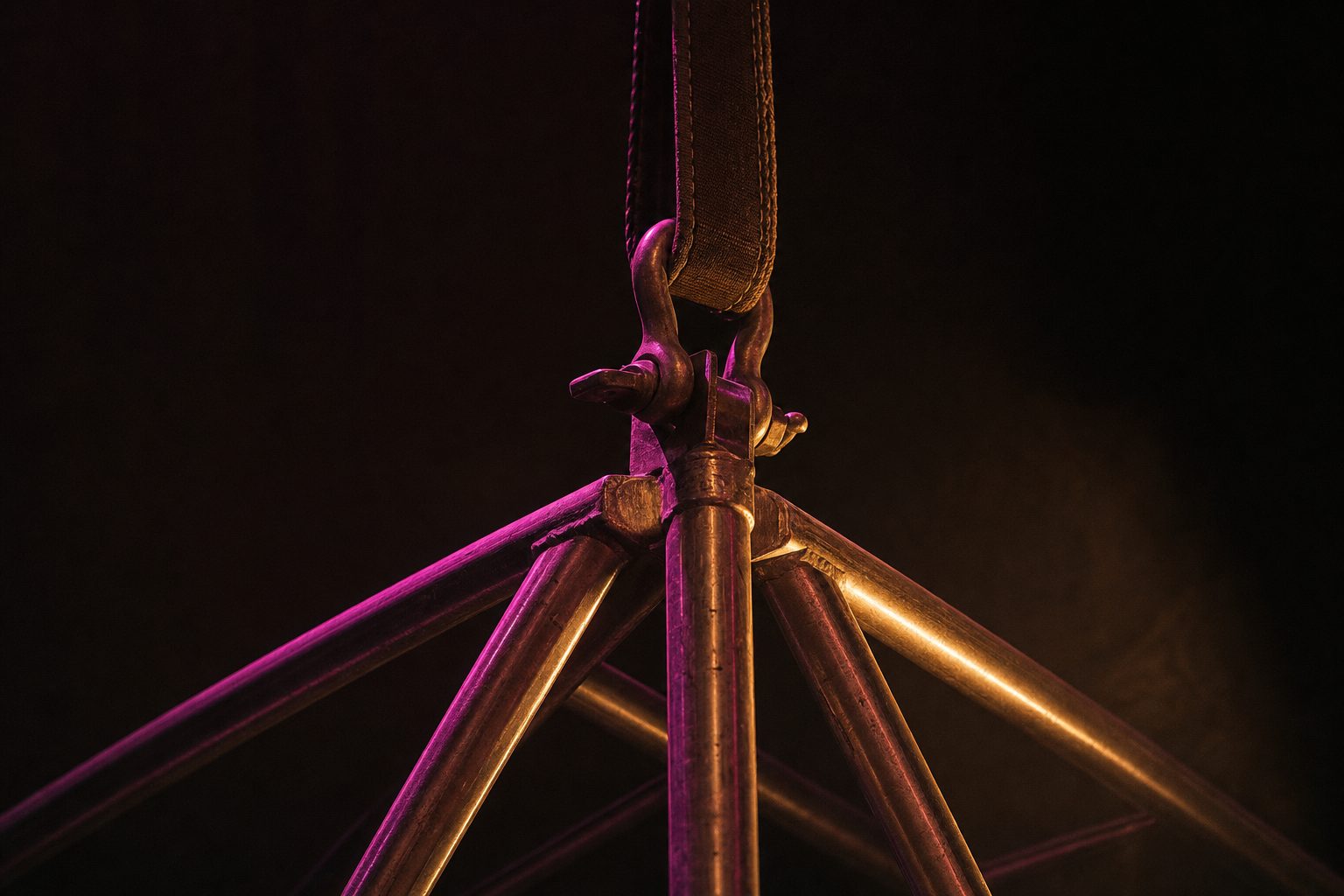
Every number in a rigging plot ends at a joint like this one. That is worth stating plainly, because the discipline is usually discussed as arithmetic and experienced as hardware: a span calculation is only as good as the point where the load actually transfers.
It is also where the schedule is decided. A hang point that has to move by two metres is a morning's work if it is found in the model and a day's work if it is found in the room, and the second version happens while forty other people wait.
Where it hands over
Stage architecture gives the LED specification its weight budget, gives projection mapping its projector positions and its surface model, and gives previs the geometry it needs to be useful. It takes almost nothing back. That asymmetry is why it has to be first.
What this trade is asked for, and when
The useful question early is not “will it hold?” but “what is the budget?” weight, hang points, span, and the positions from which anything can be aimed. Those four numbers are what every other department is actually waiting for, and they can be given long before a design is finished.
Handed over on time, they shape the design. Handed over late, they veto it. That asymmetry is why this page sits first in the design sequence despite being the least visible discipline on it, and why previs is the step that converts these limits into geometry other people can work against.
Where the constraint shows up in the archive
Two entries here are structural problems before they are visual ones. The stacked-plane design asked a venue to fly three surfaces where one was planned, and the volumetric array asked it to carry a block of panels rather than a wall of them. A fixed band shell is the opposite case: nothing to hang from and a surface the production did not design.
Terms used above are defined in the glossary.
Questions
the things people ask about thisWhat is stage architecture in a visuals context?
It is the structural design of everything the picture is mounted on or projected onto: the truss grid, the towers, the scenic build and the points they hang from. It matters to the video department because it sets the hard limits, how much an LED wall can weigh, how far a surface can span without support, and where a projector is physically allowed to be.
What is a load path?
A load path is the route a weight takes from the thing being hung down to the ground or up to the building steel. Every element in that route has a rating, and the weakest one governs. A design that ignores the load path produces a rig that looks fine on paper and cannot be hung in a real venue.
How far can truss span before it needs support?
It depends entirely on the truss type, the load, and how the load is distributed, a manufacturer span table is the only honest answer, and every reputable truss maker publishes one. What is general is the shape of the curve: capacity falls off sharply with span, so doubling the distance between supports costs far more than half the capacity.
Why do touring rigs have to fit in a small case?
Because the rig moves every day and travels by road or air. A structure that assembles from short members into something large is worth more on tour than a stronger one that ships as a single piece. Several well-known touring designs exist purely because somebody solved the packing problem, not because they solved a structural one.
Who decides whether a video element can hang?
The production rigger, working from the load path and the venue’s own capacity, and it is not a negotiation. The video department’s job is to bring the weight and the hang points early enough that the answer can shape the design rather than veto it.