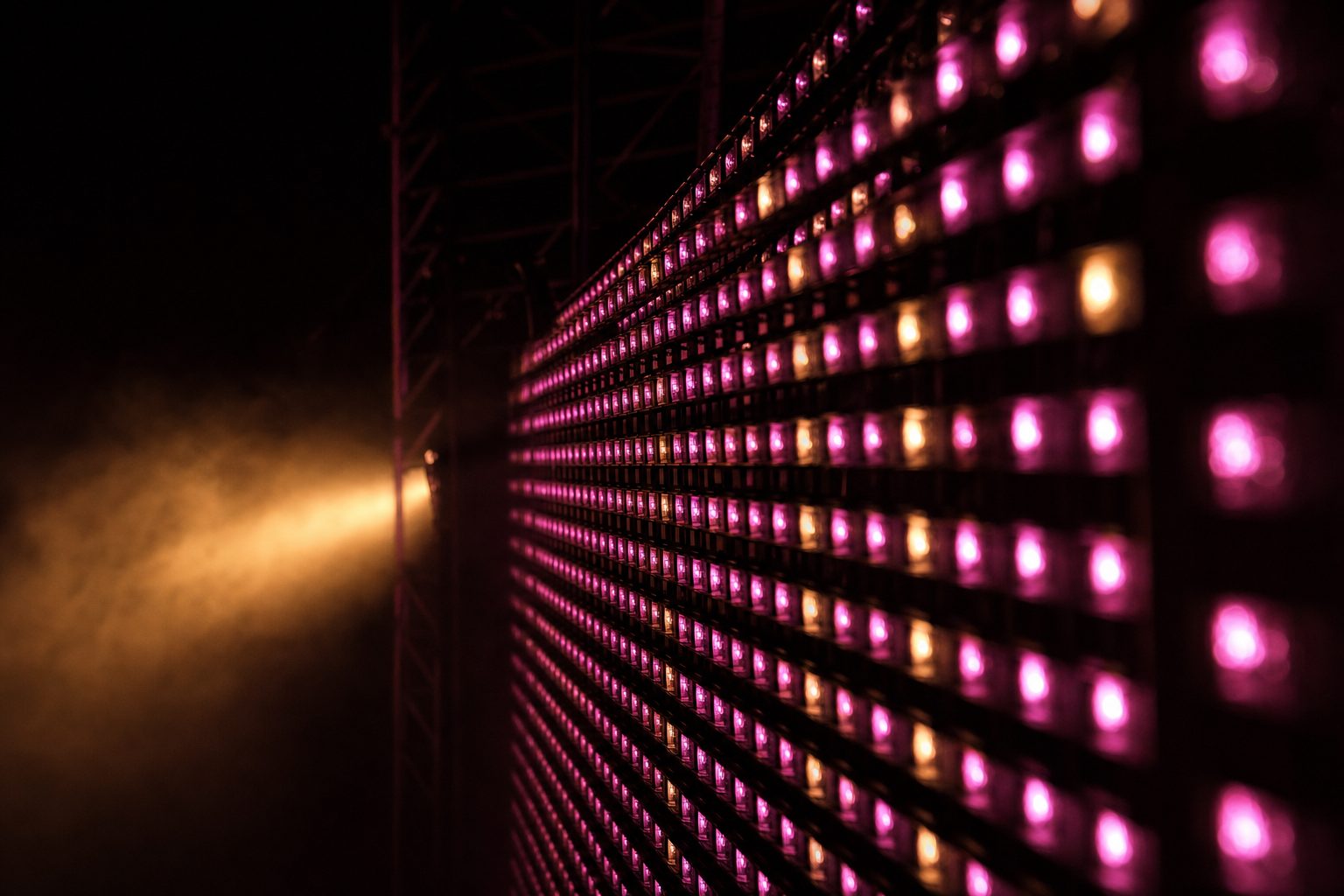
CH 02 · THE CRAFT
LED walls and volumetric depth: pixel pitch, moire and stacked panels
- DISCIPLINEVideo
- DECIDED BYSightlines
- FAILS LATEWeight
An LED wall is the only part of the picture that can compete with stage lighting and still read in daylight. Everything about specifying one is a trade between resolution, brightness, weight and the distance the audience actually sits at.
An LED wall is specified long before anyone draws content for it, and the specification constrains everything that follows. The three numbers that matter are pixel pitch, physical dimensions and weight, and only one of them is negotiable once the tour is routed.
What makes it the default surface for large-scale live show visuals is that it emits its own light. It does not care about ambient brightness in the way projection does, which is why festival main stages in daylight are wall-driven and why the same content that dies on a screen at 6 pm still reads at full strength.
Pixel pitch and the nearest seat
The correct pixel pitch is not the finest one available; it is the coarsest one that still resolves at the closest point the audience reaches. Finer pitch means more diodes per square metre, and every one of them is weight on a truss, watts in a distro and money on an invoice. A wall specified two steps finer than the room requires is a wall that costs more to fly and looks identical.
The complication is that a touring show does not have one nearest seat. It has a different one every night. Rigs are therefore specified for the tightest room on the routing, and everywhere else they are over-specified, which is a cost decision made once, at the start, on incomplete information.
Moire, and why it is a camera problem
The diodes sit on a perfectly regular grid. So does a camera sensor. When the two grids are close in scale and slightly rotated relative to each other, the beat between them produces moire, the shimmering interference pattern that appears on broadcast and not in the room.
There is no fix at the wall. What exists are mitigations: shifting the camera position, changing the shutter angle, softening the content near the frequencies that trigger it, or defocusing very slightly. On shows where the broadcast feed matters as much as the room, this argument happens early and involves everybody.
Volumetric: stacking panels in Z
A flat wall can render depth. It cannot produce it. The difference is parallax: on a rendered image, moving your head changes nothing, and the brain knows.
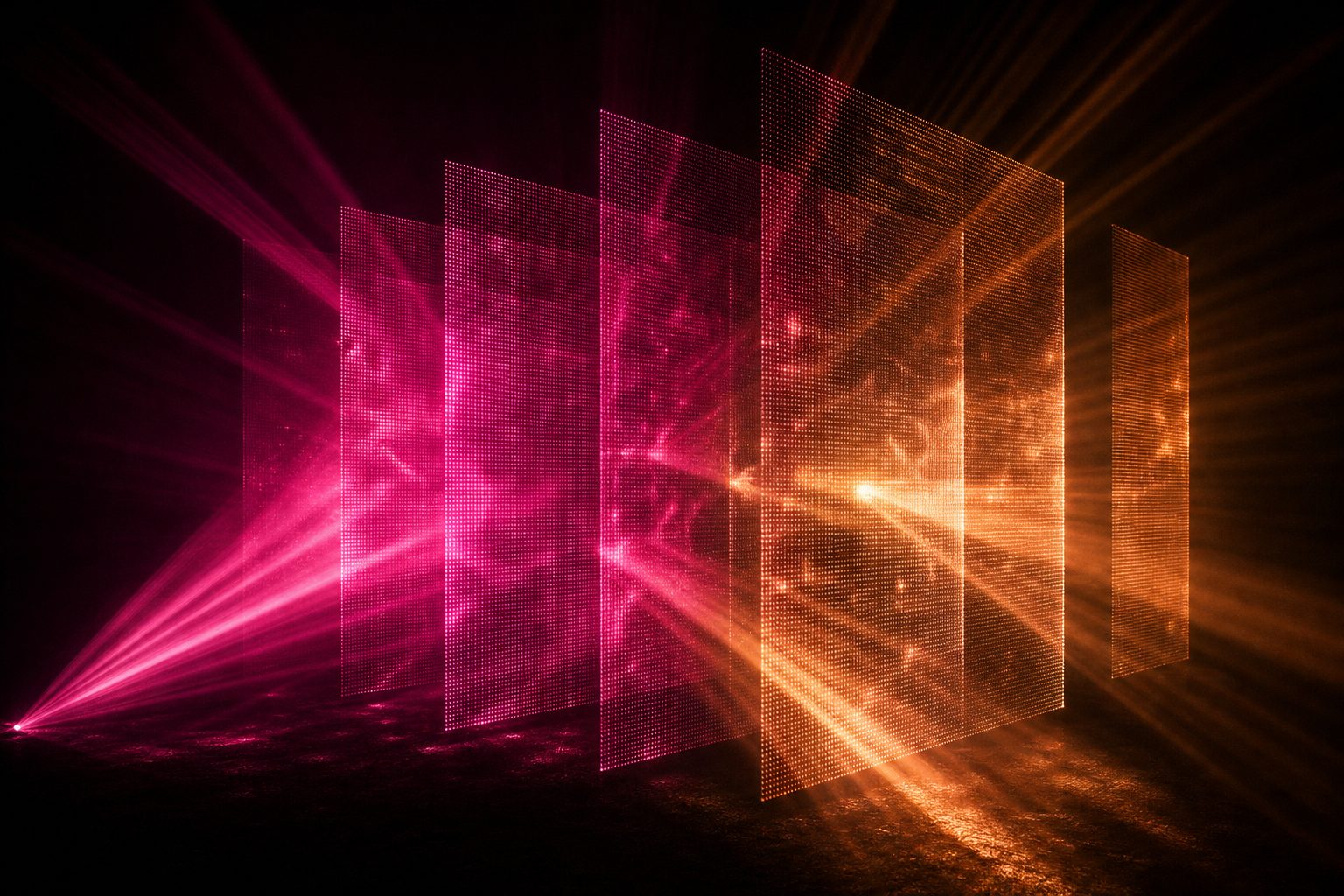
The volumetric approach places multiple low-density or transparent surfaces at intervals through the depth of the stage. Content is authored per layer. As the audience moves (or as a camera tracks), the layers shift against each other exactly as real objects at different distances do. Stacked panels of this kind are how several of the productions in the archive got their depth, and it is a rigging problem far more than a video one.
What it costs
Stage depth, first: the layers need physical separation to produce useful parallax, and that depth competes with everything else upstage. Rigging capacity, second, each layer is its own hang. And content time, because every layer is authored separately and they only work when they are designed together.
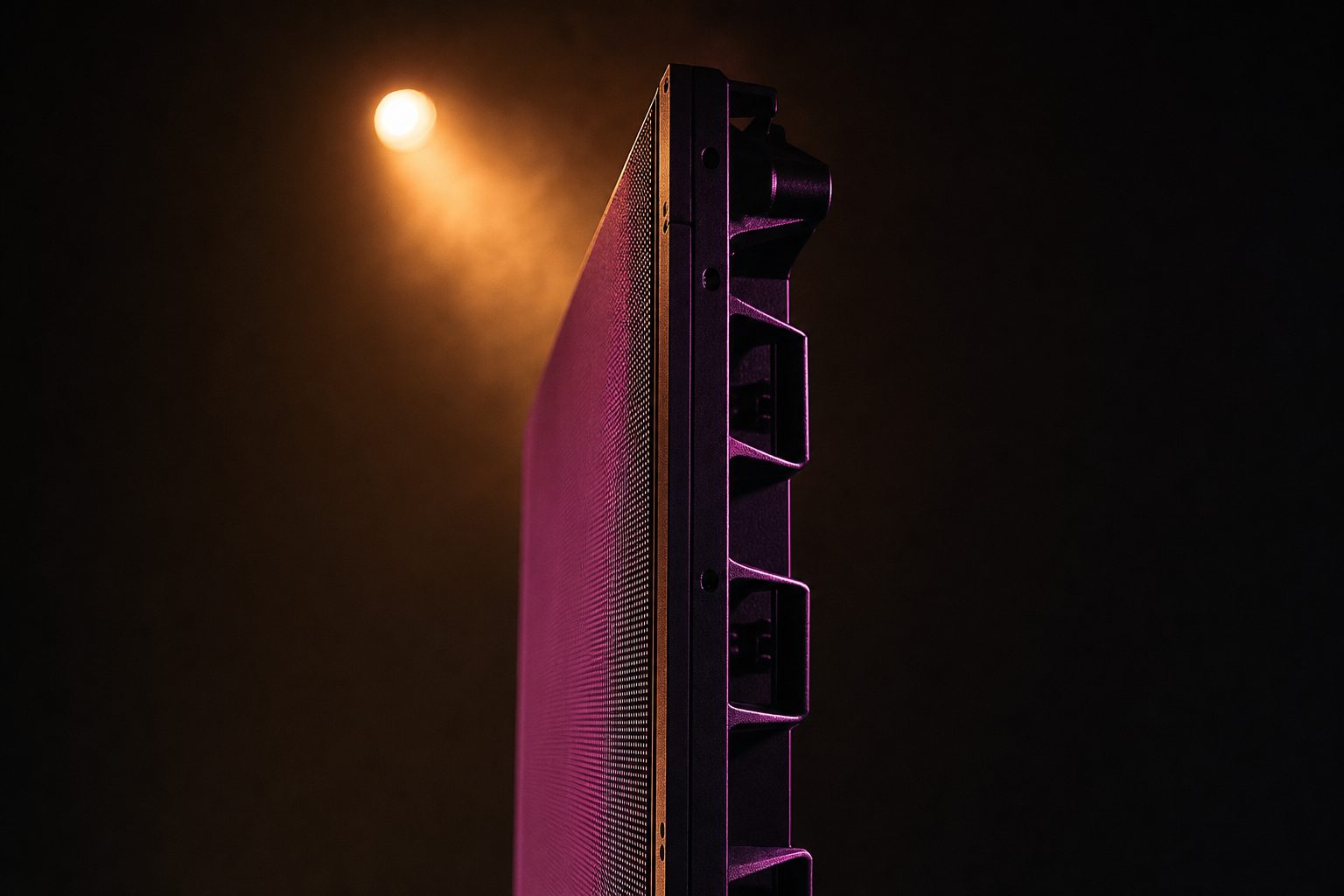
Specifications are written about the face of a panel and paid for by everything behind it. Depth, frame, power and data all live on the back, and they are what decides whether a wall can be flown in the position the design wants.
This is the reason a finer pitch is not a free upgrade. More diodes per square metre means more mass on the same hang points and more current into the same distro, so a specification two steps finer than the room requires is not merely wasteful; it can move the wall to a position where it reads worse.
Where it sits against the other trades
The wall specification is downstream of stage architecture (weight and hang points decide what is possible) and upstream of everything the content team does, because resolution and aspect are fixed by it. Where the wall cannot cover a surface, projection mapping takes over, and the two have to be colour-matched. Previs is where the sightline argument gets settled before anything is ordered.
Specifying against the nearest seat, not the average one
The honest input to a pitch decision is the distance to the closest paying seat, not the middle of the room. Almost every over-specification starts from an average, and almost every visible-grid complaint comes from the front rows, which is exactly the population an average hides.
The arithmetic is quick and worth doing before the specification is written rather than after: the pixel-pitch calculator resolves minimum comfortable distance, wall resolution across a given width, and the total pixel count a media server has to drive.
Where it appears in the archive
The volumetric array is the clearest case in this archive of panels used as an object rather than as a screen, and it is the direct descendant of the stacked translucent planes that answered the same question with projection three years earlier. The consecutive arena runs show the opposite pressure: a specification that has to load into a different building nightly.
What the wall is competing with in the same air is under light programming, and what has to be drawn for it under content creation.
Questions
the things people ask about thisWhat does pixel pitch mean on an LED wall?
Pixel pitch is the distance in millimetres between the centres of two adjacent diodes. A 2.6 mm wall has diodes 2.6 mm apart; a 10 mm wall has them ten. Smaller pitch means more resolution in the same physical area, more weight, more power and considerably more money, so the correct pitch is the largest one that still resolves at the nearest seat.
How close can an audience get before an LED wall breaks up?
A common rule of thumb puts the minimum comfortable viewing distance in metres at roughly the pixel pitch in millimetres, a 4 mm wall reads cleanly from about four metres back. It is a starting point, not a law: content matters, and a wall carrying soft abstract imagery survives far closer than one carrying text.
What causes moire on an LED wall and can it be fixed?
Moire appears when the regular grid of the wall beats against another regular grid, most often a camera sensor, sometimes fine detail in the content itself. It cannot be removed at the wall. It is managed by changing the camera angle or shutter, by softening the content, or by accepting that the broadcast feed and the in-room picture are two different deliverables.
How do you get real depth out of a flat LED wall?
By stopping it being flat. Transparent or low-density stacked panels placed at intervals in Z give genuine parallax: content on the front layer moves against content behind it as the audience shifts, which no amount of rendering on a single surface reproduces. This is the volumetric approach, and it costs depth of stage and a great deal of rigging.
Is an LED wall brighter than projection?
Substantially, and that is usually why it is chosen. An LED wall emits its own light and holds up against stage lighting, haze and daylight; projection is subtractive and needs the room dark. Most large rigs carry both and give each the job it is good at, the wall for brightness, projection for surfaces a panel cannot cover.