CH 08 · THE CRAFT
Art and production direction: who decides how a live show looks
- DISCIPLINEDirection
- DECIDESThe look
- OFTENVacant
Six technical disciplines can each do their job perfectly and still produce a show that looks like nothing in particular. Art direction is the role that stops that happening, and it is the one most often left vacant.

The six disciplines in this section describe how a live picture is built. None of them describe what it should be. Art direction is that missing layer: the decisions about the look that everything else then executes.
It is listed last here and it belongs first chronologically, which is exactly the problem. On a production where nobody owns it, it does not go away; it gets made by default, late, by whoever happens to be in the room.
What convergence looks like
Give six competent specialists a brief and no shared visual position, and each will optimise their own part sensibly. The lighting designer reaches for the beam looks that read best. The content team produces material that survives repetition. The LED spec goes a step finer than needed because finer feels safer.
Every decision is defensible and the result is generic, because the safe move in each discipline is the same safe move everyone else made this year. Distinctiveness does not emerge from competence; it has to be chosen, and then protected.
The deliverable is small and it is early
Art direction on a live show is not a large document. It is a reference set, a palette with real constraints in it, a position on abstraction, and a short list of things the show will not do.
What matters is that it exists before content starts. Content authored against nothing gets rejected in review for reasons nobody can articulate, and re-authored under time pressure, which is the single most expensive failure mode in the schedule, because content is the slowest thing in the room.
Defending it under pressure
The decisions are made early and eroded continuously. A venue forces a change. A fixture package substitutes. Somebody suggests one more element because there is space for it.
Each individual erosion is reasonable and the cumulative effect is the loss of the visual language the show was built around. Holding the line is most of the job, and it is why the role needs enough authority to say no to departments that outrank it technically.
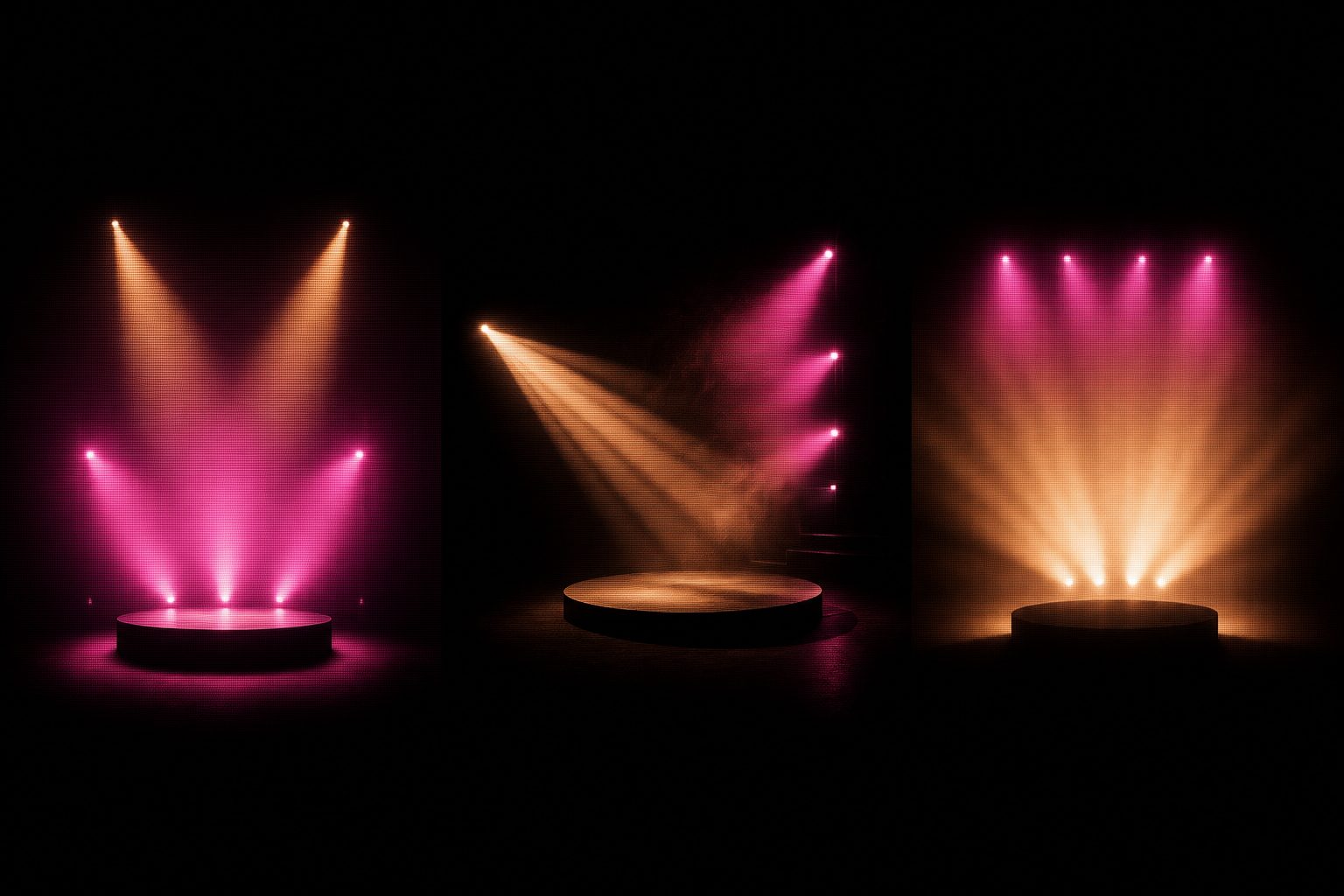
Nothing separates these three except a choice. The set is identical, the fixtures are identical, and the difference between them is the only thing on a production that no department owns by default.
That is why the seat gets left vacant so easily: every other discipline has a deliverable that fails visibly when it is missing, and this one does not. A show with no art direction is not broken. It is merely unremarkable, and by the time anyone says so out loud the decisions have already been taken by default.
Where it touches the other trades
Art direction sets constraints that stage architecture builds within, decides how much depth the wall needs to deliver, tells mapping whether registration should read as precise or dissolved, and gives the operator a position on how much the picture should move.
It is also what makes a visual identity survive across consecutive tours when the physical rig is rebuilt each time. The hardware changes; the decisions are what carry.
Why six specialists converge on the same answer
Each department, optimising honestly, moves toward the option with the fewest unknowns. Lighting reaches for the palette that reads reliably; video reaches for content that survives a bad projector day; rigging reaches for the geometry that hangs anywhere. Every one of those is the correct local decision, and together they produce a show that could be anybody's.
Art direction is the only function whose job is to accept a worse local answer somewhere for a better whole. That is an unpopular thing to be, which is the other reason the seat is empty.
Where it touches the rest
It sits above the four sequenced disciplines rather than inside them: stage architecture sets the physical budget, previs converts it to geometry, and mapping and LED divide the job of carrying the image. It also has to survive the running half, an operator playing live will default to whatever the banks make easy, so the direction has to be built into the material rather than asked for at showtime.
No program decides any of this; see the toolchain for what the software does and does not settle.
Questions
the things people ask about thisWhat does art direction mean on a live show?
It is the role that decides what the picture looks like, as distinct from how it is built. Art direction sets the palette, the visual vocabulary, the level of abstraction and the rules the other departments work inside, then defends those decisions when schedule pressure starts eroding them.
How is it different from stage design?
Stage design decides what physically exists; production design and art direction decide what it should feel like and why. In practice the same person sometimes does both, but they are separate decisions and confusing them is how shows end up structurally impressive and visually incoherent.
Why do shows without it look generic?
Because six specialists optimising independently converge on the same defaults. Everyone reaches for the safe move, the whole reads as an assembly of competent parts, and it resembles every other show that year. A visual language is a set of deliberate constraints, and constraints need an owner.
What does the role actually produce?
A small number of written and visual decisions: a reference set, a palette, rules about what the show does and does not do. On well-run productions this fits on a few pages and is agreed before content starts, because content authored against nothing is content that gets rejected late.
Who usually holds it?
It varies more than it should. Sometimes a dedicated creative director, sometimes the video designer, sometimes the artist. Where nobody holds it explicitly, it is held implicitly by whoever is loudest during load-in, which is the worst available option and surprisingly common.