CALCULATOR
Pixel pitch calculator: viewing distance and wall resolution
The right pixel pitch is the coarsest one that still resolves at the nearest seat. This works out where that seat is, and what the resulting wall costs a media server.
3.9m
MINIMUM COMFORTABLE VIEWING DISTANCE
- Strict (grid invisible)
- –
- Rule of thumb
- –
- Acceptable at distance
- –
- Wall resolution
- –
- Total pixels
- –
- Versus 1920×1080
- –
Weight, power and price all scale with diode count, not with wall area. The cheapest correct answer is the coarsest pitch that still resolves at the nearest seat.
Where the rule of thumb comes from
The shorthand every LED vendor quotes (viewing distance in metres equals pixel pitch in millimetres) is a rounded version of a real piece of geometry. Normal vision resolves detail down to roughly one arc-minute. Work out the distance at which two adjacent diodes fall inside that angle and you get the point where the grid disappears into an image.
The strict version of that calculation sits further back than the shorthand suggests, and in practice audiences accept the wall well before the grid is mathematically invisible. The calculator gives all three numbers because a specification argument usually involves all three.
Content changes the honest answer
Two walls of identical pitch behave differently depending on what is on them. Soft, moving, abstract imagery has no crisp detail for the diode grid to fight with, and reads cleanly much closer than the rule implies. Text and hard graphic edges do the opposite; they give the eye something exact to compare the grid against, and the wall breaks up sooner.
This is why a festival wall carrying atmospheric content can be specified a step coarser than an arena wall carrying titles, at the same audience distance, with nobody noticing.
Total pixels: the number that surprises people
Pitch and physical size together fix the resolution, and that resolution has to be produced by a machine. A twelve-metre wall at fine pitch can exceed a common server's output capability, and the discovery usually happens when content arrives at full resolution and will not play.
The calculator reports total pixel count and the multiple of a 1080p frame, because that multiple is the number worth checking against whatever is driving the wall; see the toolchain for what typically does.
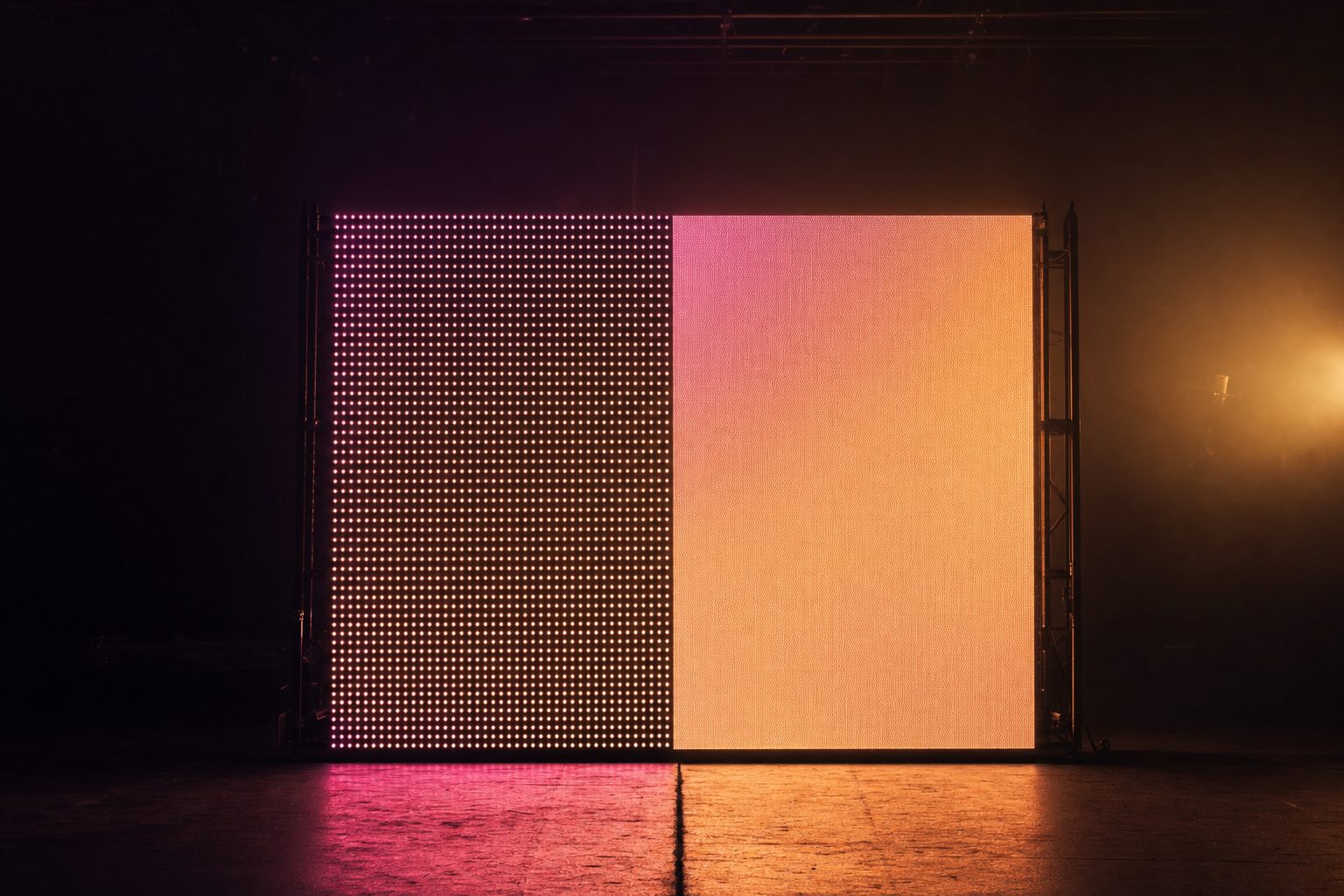
Held side by side at this distance the difference is obvious. From the back of a room it is not, and from most of the seats in a large venue it never was, which is the whole reason over-specification is the most common and most expensive error in this part of the job.
The decision that matters is the distance to the nearest paying seat, not the average distance to the audience. Almost every visible-grid complaint comes from the front rows, and an average is exactly the number that hides them.
Why over-specifying is the common error
Finer pitch feels safer. It is not free: diodes per square metre rise sharply, and with them weight on the truss, power draw and cost. A wall two steps finer than the venue requires looks identical from every seat in the room and costs substantially more to buy, fly and power.
The constraint that actually decides it is the nearest seat, and on tour that is the nearest seat in the tightest room on the routing, a decision made once, early, on incomplete information. The trade is discussed in full under LED and volumetric, and the rigging consequences under stage architecture.
What a finer pitch actually buys, and charges
It buys resolution at close range and nothing at all beyond the distance where the grid was already invisible. It charges on every axis that matters physically: more diodes per square metre is more mass on the same hang points, more current into the same distribution, and more money to buy, fly and power.
A wall specified two steps finer than the room requires therefore looks identical from every seat and can end up hung in a worse position because of what it weighs. That is the failure mode worth guarding against, and it is a specification decision rather than a content one.
Where this fits
The wall's physical envelope is limited by what the venue will carry, and the specification itself is documented under LED and volumetric. The total pixel count this produces is what content creation has to draw for and what the media server has to render every frame.
The equivalent arithmetic for projection is the throw-distance calculator. In this archive the clearest case of panels specified as an object rather than a screen is the volumetric array.
Questions
the things people ask about thisWhat is the pixel pitch rule of thumb?
The common shorthand is that minimum comfortable viewing distance in metres roughly equals the pixel pitch in millimetres, a 4 mm wall reads cleanly from about four metres. It is a starting point, not a law, and the calculator above also gives the stricter and looser variants people actually argue about.
Where does that rule come from?
From visual acuity. A person with normal vision resolves detail down to about one arc-minute, and the distance at which adjacent diodes fall inside that angle is where the grid stops being visible. The 1 m-per-1 mm shorthand is a rounded version of that geometry.
Does content change the answer?
Considerably. Soft, abstract, high-motion imagery survives far closer than fine text or hard graphic edges, because there is no crisp detail for the grid to interfere with. A wall carrying only atmospheric content can be specified a step coarser than the same wall carrying titles.
Why does total pixel count matter?
Because it is what the media server has to render, decode and output every frame. A wall can be geometrically sensible and still exceed the output capacity of the machine driving it, which is a specification failure that only appears when the content arrives.
Is a finer pitch always better?
No, and this is the most common over-specification in the field. Finer pitch means more diodes per square metre (more weight on the truss, more power, more money) for a difference nobody in the room can see. A wall specified two steps finer than the venue requires looks identical and costs a great deal more.