
CH 05 · THE CRAFT
VJ workflow: clip banks, tempo lock and live cutting
- DISCIPLINEVideo
- RUNSLive
- REHEARSALRarely
A VJ runs the picture in real time, against music that has never been played exactly this way before. Everything in the workflow exists to make that survivable, which mostly means deciding in advance so there is less to decide at 1am.

Of the six disciplines, VJ workflow is the only one that happens in front of the audience. Everything else is finished before the doors open. This one is a performance, and it is usually a performance of material the performer has not rehearsed against.
That constraint shapes the entire craft. A VJ is not primarily improvising imagery; they are executing a set of prepared decisions fast enough to stay with the music. The preparation is where the work is.
Clip banks: organised for the hand, not the eye
A clip bank is the library of material available during the show, laid out on a grid. The temptation is to organise it the way a file system is organised, by name, by project, by date. Every experienced operator abandons this quickly, because at showtime nobody reads.
What works is organisation by energy and by function. Beds and textures where the hand rests. Builds within easy reach. Hits and stabs somewhere distinct enough that they cannot be triggered by accident. Blackouts somewhere unambiguous. The layout is a muscle-memory instrument, and it is rebuilt for each artist rather than inherited.
Tempo lock and the drift problem
Content is authored at a tempo. Music is performed at a slightly different one, and a DJ set changes tempo repeatedly across the night. Without tempo lock, a loop cut for 128 BPM played against 124 drifts a full beat inside about thirty seconds, and from there it never recovers.
Tempo lock resamples playback to the incoming beat, whether that comes from a clock signal, a tap, or beat detection. It is the single most load-bearing feature in the entire VJ workflow, and a rig without a reliable clock source is a rig where the operator spends the show nudging.
Layering and live cutting
Almost nothing on screen is one clip. A typical live output is a bed, a mid layer carrying the motion, a top layer for hits, and a global effect or colour treatment across all of them. Layering in this way means intensity can be changed without changing material, bring the top layer up for a drop, take it out for a breakdown, and the picture reads as a different scene while ninety per cent of it is unchanged.
Live cutting is then mostly about restraint. The most common failure in inexperienced operation is cutting too often: the picture becomes busy, nothing registers, and there is nowhere left to go when the music actually does something.
Working a set you do not know
The honest condition of the job is that the set list is provisional and the arrangement is not the record. What can be prepared is the shape: where this artist tends to place breakdowns, how long their builds run, which tracks are likely and what they demand.
The defensive principle is that no cue should depend on what happens next. If a build is prepared and the drop does not come, there must be somewhere to go that is not a mistake.
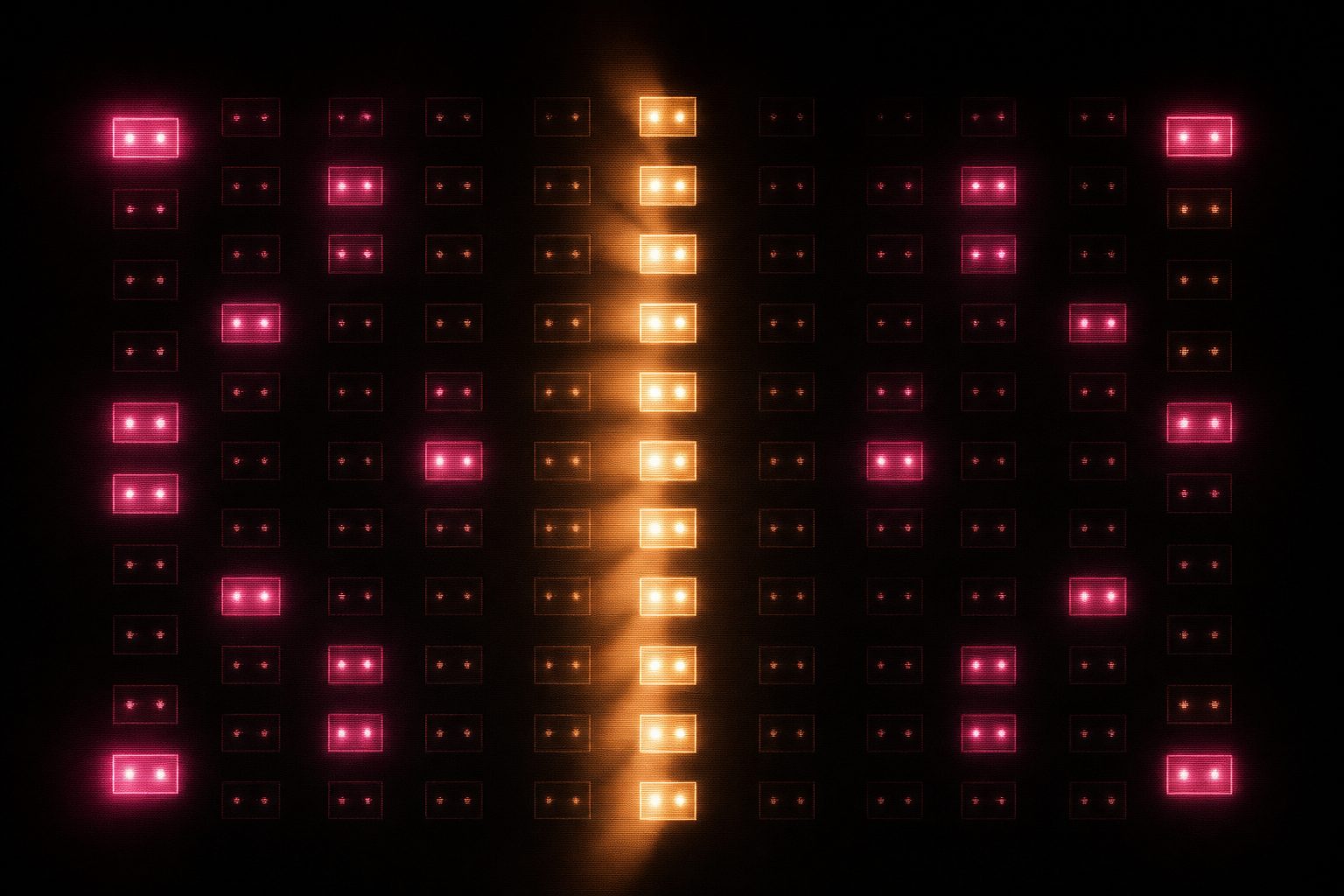
The grid is not storage, it is an instrument layout. Columns that fire a whole look at once and rows that always mean the same kind of material are what let an operator play without reading, and the arrangement matters more than the contents.
The test of a bank is not how good it looks when hit correctly. It is what happens when it is hit wrongly, whether the mistake reads as a choice or as an accident. Banks built so that adjacent cells are near-neighbours make errors survivable; banks organised alphabetically do not.
What it depends on
The bank is filled by content creation, the surfaces it plays onto are defined by the LED specification and projection mapping, and the boundary with light programming is negotiated per show. The software is usually Resolume, with Notch where blocks need to be generated live rather than played back.
Working with no rehearsal
Most shows of this kind are never rehearsed. A festival slot is a changeover, a support set is a line check, and a headline run gets one production rehearsal if the schedule holds. Preparation is what substitutes, and it takes a specific form: every decision that can be made in advance is made in advance, and everything that cannot has a default that is acceptable if nobody touches it.
That is also the honest answer to why this discipline looks like filing from outside. The performance is real, but almost all of it was decided in a room weeks earlier.
What this depends on, and what it hands over
It is downstream of everything. The material comes from content creation, the canvas from mapping or the wall specification, and the air is shared with the lighting rig. It hands over nothing except the show itself, which is why unresolved decisions upstream all arrive here at once.
What it is played on is covered under the clip-and-layer instrument, with real-time rendering as the alternative when the picture has to react rather than play back. The productions where these practices were worked out are in the archive.
Questions
the things people ask about thisWhat does a VJ actually do during a show?
A VJ plays the visual picture live: selecting from clip banks, layering sources, applying effects and cutting between them in response to what the musicians are actually doing. On a timecoded show much of this is locked; on a DJ or improvising set almost none of it is, and the VJ is performing.
What is tempo lock and why does it matter?
Tempo lock ties clip playback speed to the music’s beat, so a loop authored at 128 BPM stays in time when the track is 124. Without it, visual motion drifts against the music within a few bars and the picture stops feeling connected, which the audience registers long before they can say why.
How are clip banks organised?
By energy and by function, almost never by name. A workable bank puts the low-intensity beds where the hand goes by default, the builds and hits somewhere reachable under pressure, and anything that must never fire accidentally somewhere it cannot be hit. The organising principle is what the hand can find without the eyes.
How much of a live show is improvised?
It varies enormously. A timecoded arena show may be almost entirely locked, with the VJ handling exceptions. A festival DJ set may be entirely live. Most touring shows are hybrid (locked sections around free ones) and the difficult skill is moving between the two modes cleanly.
What happens when a VJ has not heard the set?
Which is normal. The answer is structural: know the shape rather than the notes. Learn where the drops and breakdowns tend to sit in that artist’s sets, build clip banks that can go up or down in energy from anywhere, and never build a cue that only works if the next eight bars are what you expect.