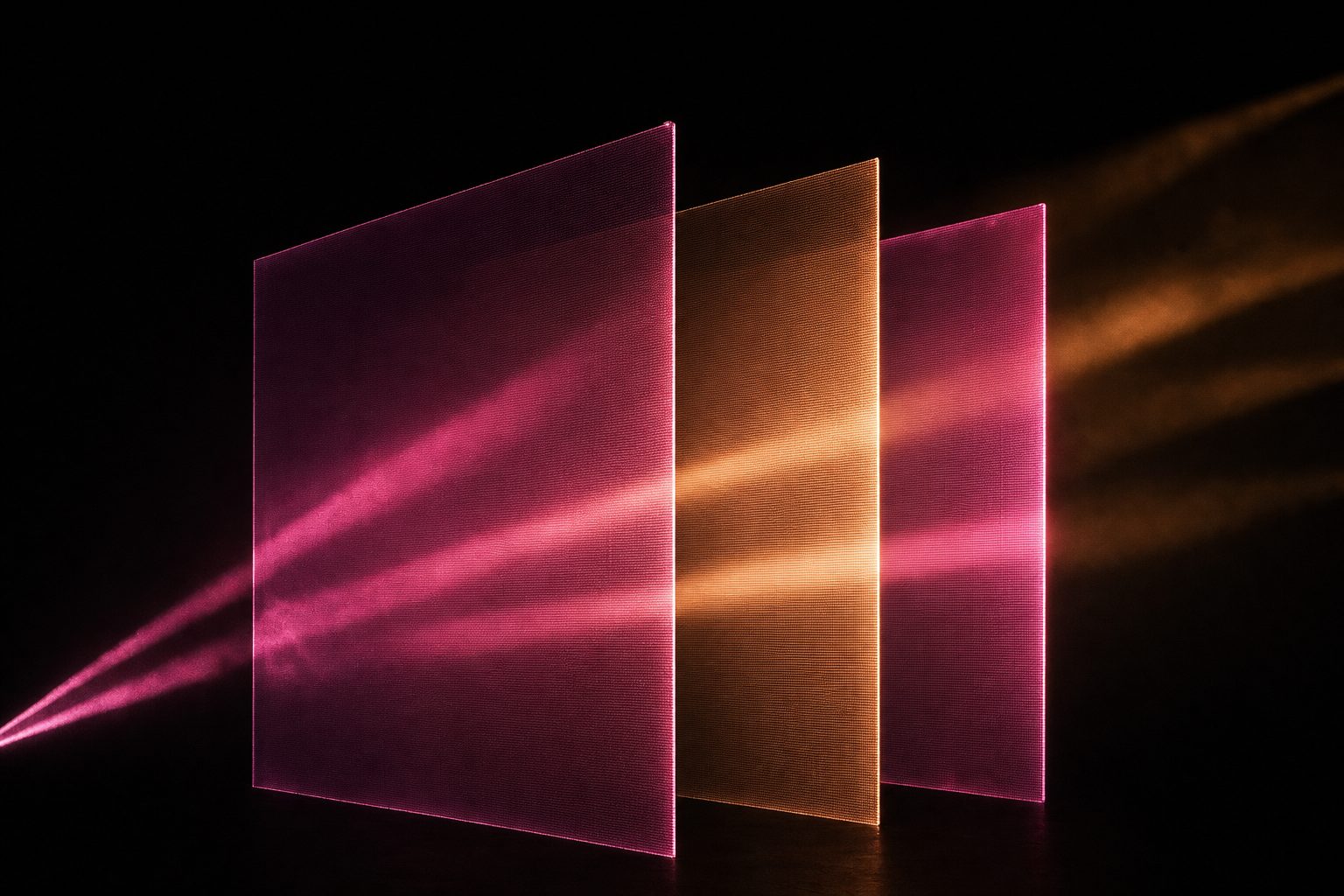
THE PRODUCTIONS
Layer3: a performance sculpture in three planes, built for depth
- YEAR
- 2014
- FOR
- Flying Lotus
- DISCIPLINE
- Projection · Rigging
Layer3 answered a question most stage designs avoid: how do you give a flat picture real depth, rather than a rendering of depth? The answer was to stop using one surface.
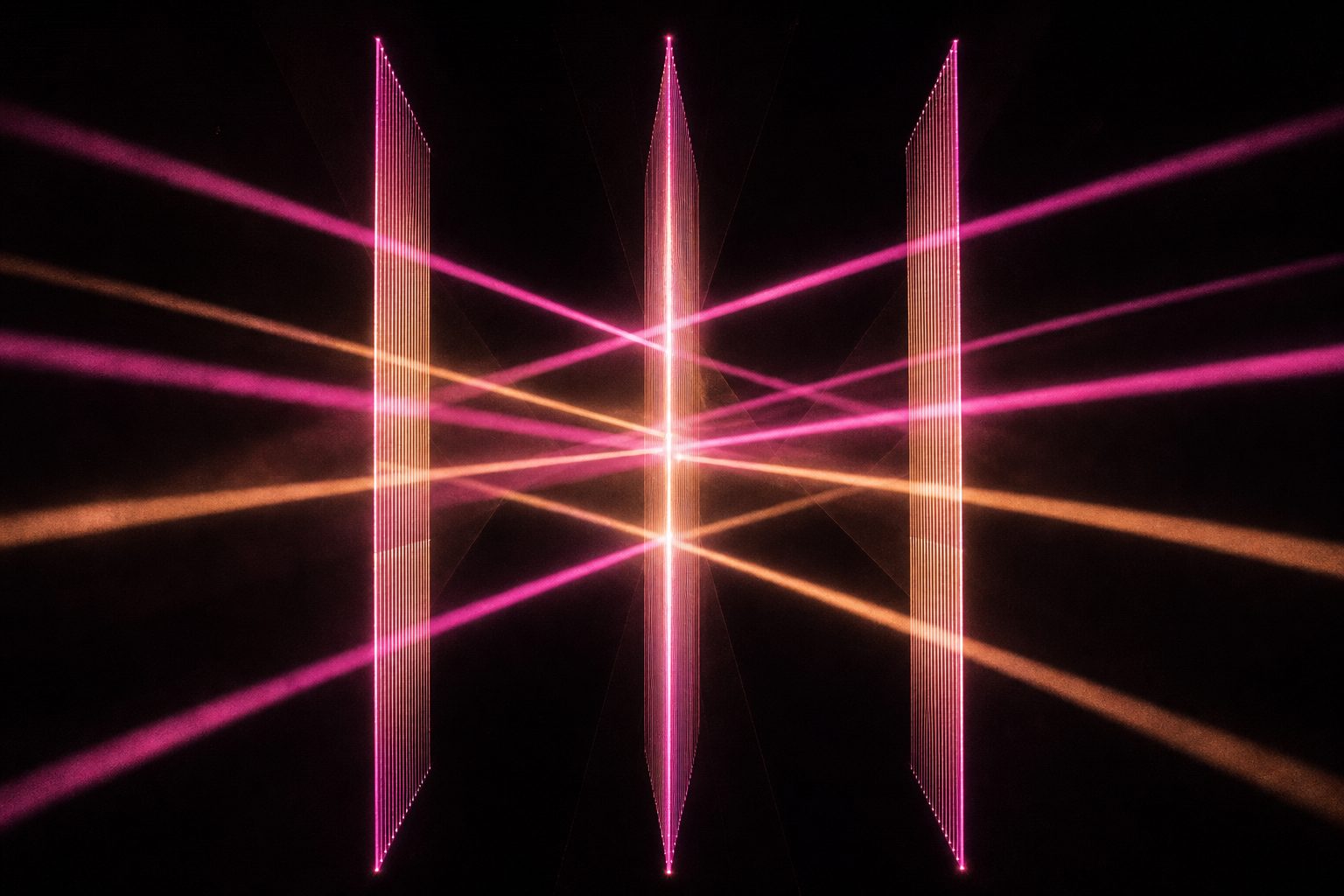
Layer3 is worth documenting because it solved a problem by refusing the obvious answer. The obvious answer to “the picture looks flat” is more resolution, better content, a bigger surface. Layer3 instead used three planes of translucent material at intervals through the stage, with the performer positioned inside them.
The result is that the image occupies a volume. Elements on the front plane genuinely sit in front of elements behind, and shifting a metre in the audience changes their relationship. No amount of rendering on a single surface reproduces that, because the missing ingredient is not detail; it is parallax.
Authoring for three surfaces at once
Content for a stacked design is not one piece divided up. Each plane carries its own material, and the planes are composed together, which means the design only exists when all three are running. Reviewing one layer in isolation tells you almost nothing.
It also inverts a normal assumption about density. Because everything downstage is seen through, front-plane content has to stay sparse. Fill the front layer and the rear planes disappear, and with them the reason for the whole structure.
What it cost
Stage depth and rigging. Three surfaces means three hangs, three load paths, and enough physical separation between them to produce the parallax, depth that competes with everything else upstage. This is a design that gets worse, not merely smaller, when it is compressed for a shallow room.
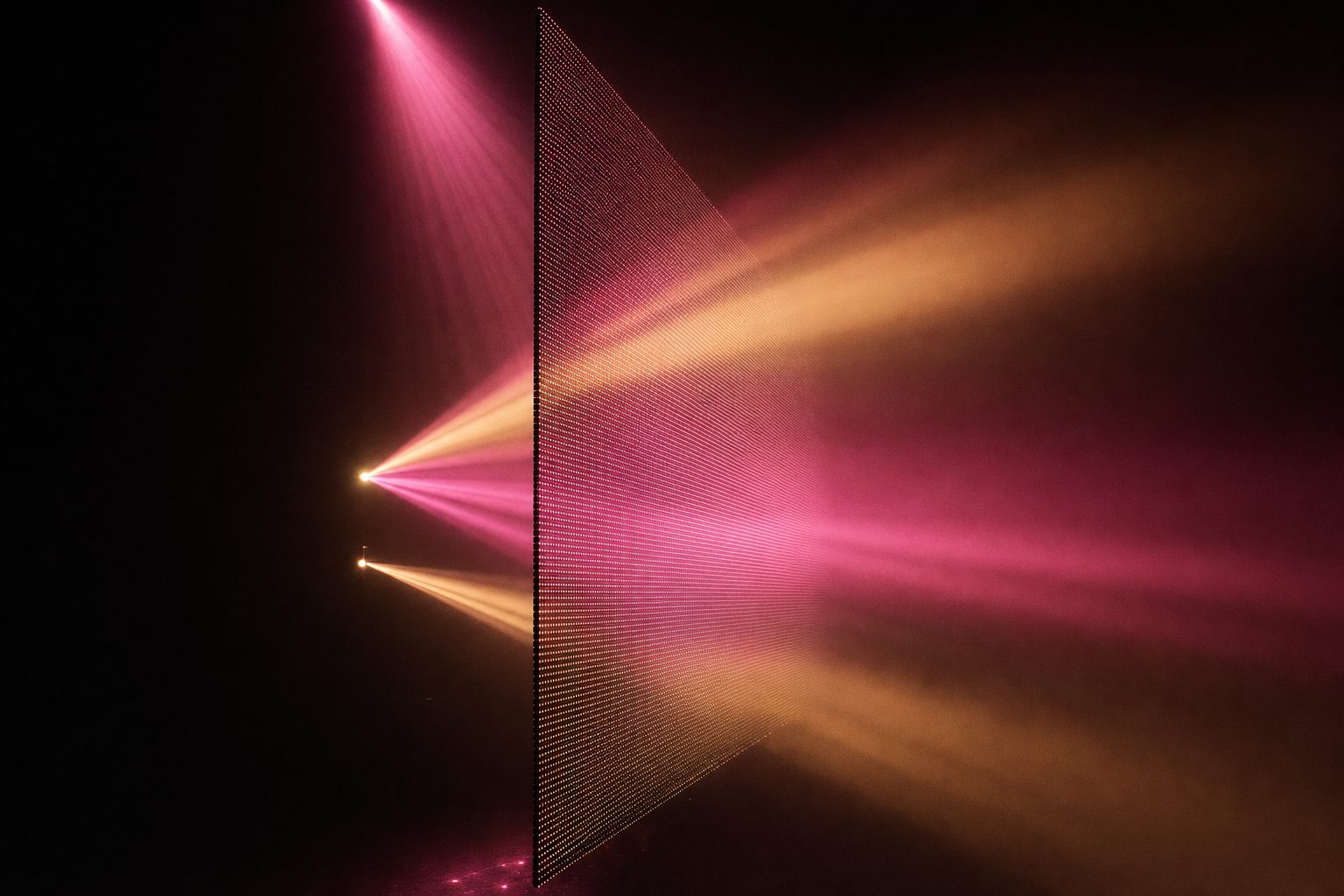
The single most reproduced finding here is also the least technical: a plane you can walk behind is read by an audience as an object, and a plane you cannot is read as a picture. Nothing about resolution changes that, which is why adding pixels to one surface never produced the same effect as separating three.
The consequence for authoring is that each plane has to be composed as a thing in its own right rather than as a slice of one image. A layer that only makes sense in combination with the other two collapses the moment a viewer moves far enough sideways to see them apart, which, in a room rather than a render, is most of the audience.
What it established
The stacked-surface approach set out in Layer3 is now a standard tool, and its descendants appear throughout the archive here, most directly in Hypercube, which took the same instinct and closed it into a solid, and in the volumetric LED work that arrived a few years later using panels rather than projection. The technique is covered as a discipline under LED and volumetric.
Where the technique went next
Physical separation as a substitute for resolution recurs throughout this archive. It appears next as a closed form in the mapped cube, where the surfaces are faces of one object rather than free-standing planes, and it returns in volumetric LED three years later with panels doing the job that translucent projection surfaces did here.
The discipline that carries it is documented under LED and volumetric, which sets out why depth built from separated emitters behaves differently from depth drawn into a flat image. The rigging half (what it costs to fly three surfaces where one was planned) is under stage architecture.
How this page is sourced
What is recorded: the design intent, the number and arrangement of surfaces, the reason given for choosing separation over resolution, and the touring consequences. What is not recorded: exact fixture counts, projector models, lumen figures or content file specifications. Those appear in trade coverage inconsistently and are not reproduced here where a single source cannot be identified.
Coverage published at the time is gathered under the field in print, with publisher and date on every entry. The terms above, volumetric and load path and layer, are defined in the glossary instead of being glossed again in the body. What this site is, how it is written and where its material comes from is set out on about this site.
Questions
the things people ask about thisWhat was Layer3?
Layer3 was a touring performance sculpture built around three planes of translucent projection surface, stacked in depth with the performer inside the stack. Content was authored per plane, so the layers moved against one another as the audience shifted, producing genuine parallax rather than rendered depth.
Why use three surfaces instead of one high-resolution screen?
Because resolution and depth are different problems. A single surface, however fine, produces an image the eye reads as flat, because moving your head changes nothing. Separating the picture across three planes gives real physical separation, and the brain registers it immediately.
How was the performer integrated into the sculpture?
By being placed inside the stack rather than in front of it. With a surface in front of the performer as well as behind, the performer becomes an element within the picture at a specific depth, which is why the design reads as a performance sculpture rather than as a musician with a backdrop.
What made Layer3 difficult to tour?
Depth of stage and hang count. Each plane is its own rigging problem and the separation between them is what produces the effect, so the design cannot be compressed for a shallow venue without losing the thing it exists for.
Where can the design be seen documented?
Contemporary coverage of the Flying Lotus live show from that period documents the three-plane construction in detail, and the surviving press index on this site collects the pieces that describe it. See the field in print.