THE PRODUCTIONS
Pardon My French: an LED array resolving true volumetric depth on tour
- YEAR
- 2017
- FOR
- DJ Snake
- DISCIPLINE
- LED · Rigging
Rendered depth is a picture of depth. A volumetric array has actual depth, content occupying real space, at real distances, which the eye resolves without being asked to believe anything.
The volumetric LED array is the emissive answer to a question that the stacked-plane projection designs asked first: how do you give a picture real depth rather than a rendering of it?
The answer is the same. Stop using one surface. What changes is the technology (panels that emit their own light rather than surfaces that receive it) and that change buys brightness, which buys festivals and daylight.
Real parallax versus rendered parallax
A flat wall showing dimensional content produces one image, geometrically correct from one notional viewpoint and slightly wrong everywhere else. Audiences do not consciously notice this, but they do not read it as depth either.
An array with elements at genuinely different distances produces correct parallax from every seat simultaneously, because it is not simulating anything. This is the entire argument for the technique, and it is why the effect survives being photographed badly.
Authoring: a scene, sampled per layer
Content for stacked panels is not drawn per layer by hand. The workable approach builds a 3D scene and samples it at each layer’s position, so the layers are automatically consistent, a form moving through the volume appears on each panel exactly when it passes.
That makes this a rendering problem, and it is why real-time tools such as Notch and TouchDesigner appear wherever volumetric work does.
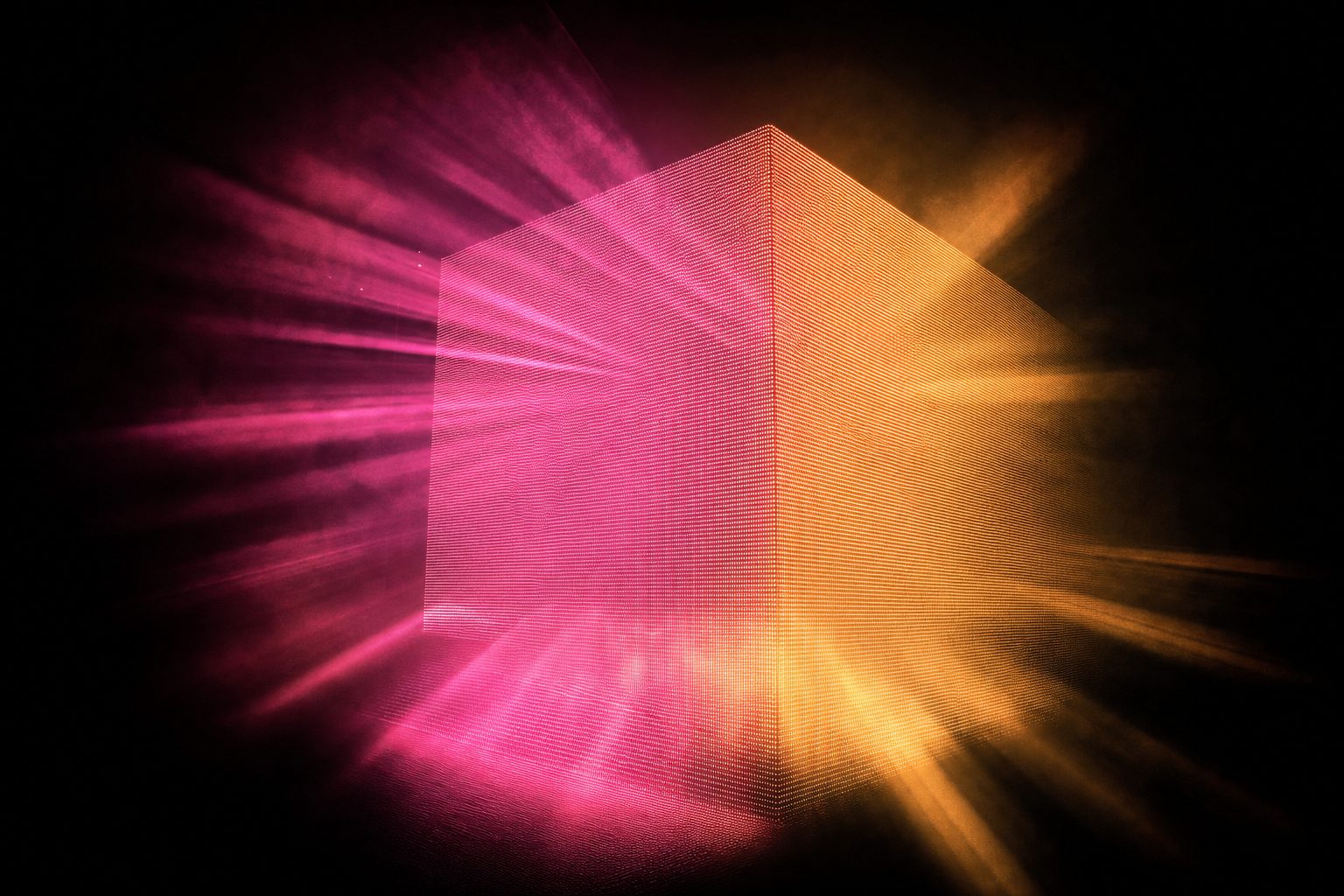
Rendered parallax is a picture of depth; this is depth. The distinction is only visible when a viewer moves, which is exactly what an audience in a room does and a camera on a tripod does not, and it is why the effect reads live and photographs poorly.
Authoring follows from that. A scene has to be sampled per layer rather than rendered once and sliced, because each plane of emitters is showing its own view of the same space rather than a band of one image.
What the road charges for it
Depth of stage, first, and it competes with everything else upstage. Hang count, second: each layer is a separate load path. Setup time, third, because the layers have to be positioned accurately relative to one another or the composition drifts.
The technique is covered as a discipline under LED and volumetric.
Where the technique went next
This is the direct descendant of the stacked translucent planes of three years earlier: the same finding that separating a picture physically beats increasing its resolution, attempted with panels that make their own light instead of surfaces that need a projector. The intermediate closed-form attempt is the mapped cube.
The discipline is documented under LED and volumetric, and what a block of panels rather than a wall of them costs to fly is under stage architecture. The specification arithmetic is in the pixel-pitch calculator.
How this page is sourced
What is recorded: the design intent, the arrangement, the technical problem it set out to answer, and the consequences for touring. What is not recorded: fixture counts, equipment models, lumen figures or content specifications, which appear in trade coverage inconsistently and are not reproduced where a single source cannot be identified.
Reporting from the period sits under the field in print, each piece listed with its publisher so a reader can judge the source rather than take the summary on trust. Volumetric, load path and layer are defined in the glossary. The remit behind the page and what gets documented is set out on about this site.
One caution about the record: almost every surviving image of this design is a photograph or a broadcast frame, and both flatten precisely the effect the design existed to produce. The archive is therefore systematically misleading about it, which is worth knowing before drawing conclusions from the pictures.
Questions
the things people ask about thisWhat is a volumetric LED array?
An arrangement of LED elements distributed through depth rather than across a single plane, stacked panels, strands or low-density surfaces spaced apart in Z. Content is authored per layer, so the array displays a form that genuinely occupies space rather than an image of one.
How is that different from 3D content on a flat wall?
A flat wall showing rendered 3D produces one image, correct from one notional viewpoint. Moving your head changes nothing, and the eye knows. A volumetric array gives real parallax from every seat, because the elements really are at different distances.
What does it cost to tour?
Stage depth, hang count and setup time. Every layer is its own rigging problem with its own load path, and their spacing is the effect, so the design cannot be compressed for a shallow venue without losing the thing it exists for.
How is content authored for a volumetric array?
Per layer, composed together, and almost always generated rather than hand-drawn. The natural authoring approach treats the array as a 3D scene and samples it at each layer’s position, which is a rendering problem more than a graphics one.
Is it related to the earlier stacked-plane projection designs?
Directly. It is the same instinct (separate the picture in depth rather than increase its resolution) executed with emissive panels instead of projection, which makes it far brighter and viable outdoors.